
How to manage feature requests at an early startup
 Baltej Singh9 min read
Knowing how to manage feature requests at an early startup comes down to three habits. Put every request in one log with the same few fields, decide on each one within a week using written criteria, and tell the customer what you decided even when the answer is no. Then count the log once a month, so the roadmap follows patterns across customers instead of the loudest email.
Most small teams handle requests the other way around. A big prospect asks for single sign-on on a sales call, the founder says "we're looking at that," and the note lives in one person's head. Three weeks later a support ticket asks for the same thing in different words, and nobody connects the two. Six months later, the team has a vague sense that "people want integrations" and no way to say which people, how many, or what they would pay.
The process below fits a team of two to fifteen people with no product manager. It takes about an hour to set up and thirty minutes a week to run.
What counts as a feature request?
Before you build a log, agree on what goes in it. Mixing bugs, how-to questions and real requests in one pile is the fastest way to make the pile useless.
Type | Example | Where it goes |
|---|---|---|
Bug | "Export to spreadsheet stopped working after the update." | Bug tracker, fixed on its own schedule |
How-to question | "Can I change the date format on invoices?" (and it already exists) | Support reply, plus a note if the setting was hard to find |
Feature request | "I'd like to export to spreadsheet on a schedule every Monday." | Feature request log |
Complaint about pricing or plans | "Too expensive for a team of three." | Sales or pricing notes, not the product log |
A how-to question can still be useful. If five people in a month cannot find the same setting, that is a request for better design, and it belongs in the log under that name. If you need a system for sorting incoming support messages first, see customer support triage for startups.
Log every request in one place with the same fields
Requests arrive from sales calls, support email, chat, social posts and conversations at events. The log needs to be one place that all of those feed into, with a person responsible for keeping it tidy. In a team this small, that is usually a founder.
Keep the fields short. If logging a request takes more than a minute, people stop doing it.
Field | What to write | Example entry |
|---|---|---|
Request, in the customer's words | Quote them, do not paraphrase | "I want to export the report every Monday without logging in." |
Underlying problem | What they are trying to get done | Send a weekly report to their boss |
Who asked | Name and company | Example: Priya, operations lead at a 40-person agency |
Customer status | Paying, trial, prospect, churned | Paying, annual plan |
Where it came from | Call, email, chat, event | Sales call |
Date | When they asked | 2026-11-04 |
Decision | Blank until reviewed |
The two most important fields are the quote and the underlying problem. Customers usually describe a solution. Your job is to find the problem behind it, because there may be a cheaper fix. In the example above, a scheduled email of the report might solve it without building a full export scheduler.
When the same problem shows up again, add the new customer to the existing row instead of creating a new one. That one habit is what turns a list of complaints into a count you can use.
How to manage feature requests without promising dates
The hardest part is the conversation. A paying customer asks for something, and saying "great idea, we'll build it" feels like good service. It is not. Every vague yes becomes a promise someone remembers, and a list of unkept promises is how small companies lose trust.
Decide each new request within a week, using one of four outcomes:
Decision | When to use it | What happens next |
|---|---|---|
Building now | Fits the current plan, and you can name the month it ships | Goes on the roadmap with an owner |
Considering | Real problem, several customers, but not this quarter | Stays in the log and gets counted monthly |
Not now | Small group of customers, or it pulls you toward a market you are not chasing | Logged, revisited only if the count grows |
No | Conflicts with what the product is for, or one customer's edge case | Logged with the reason, customer told plainly |
Write the reason next to every decision. When the same request comes back in three months, you will want to know why you said no the first time and whether anything has changed.
A few rules keep this honest:
- Never give a ship date unless the work is already scheduled with an owner.
- A request from a prospect counts, but weigh it below a paying customer with the same problem. Prospects sometimes ask for things they would not pay for once the product is in front of them.
- One very large customer asking for something is a sales decision as much as a product one. Make it with whoever owns revenue in the room.
Reply to the customer the same week
People who take the time to ask deserve an answer, and a clear one is more useful to them than silence. Short replies work best. Here is a set you can adapt for each decision:
- Building now: "Thanks for asking about this. It's on our plan for next month, and I'll message you when it's live."
- Considering: "I've added this to our request log with your details. Other customers have asked for something similar, and we review the list monthly. I won't promise a date, but I'll tell you if it moves forward."
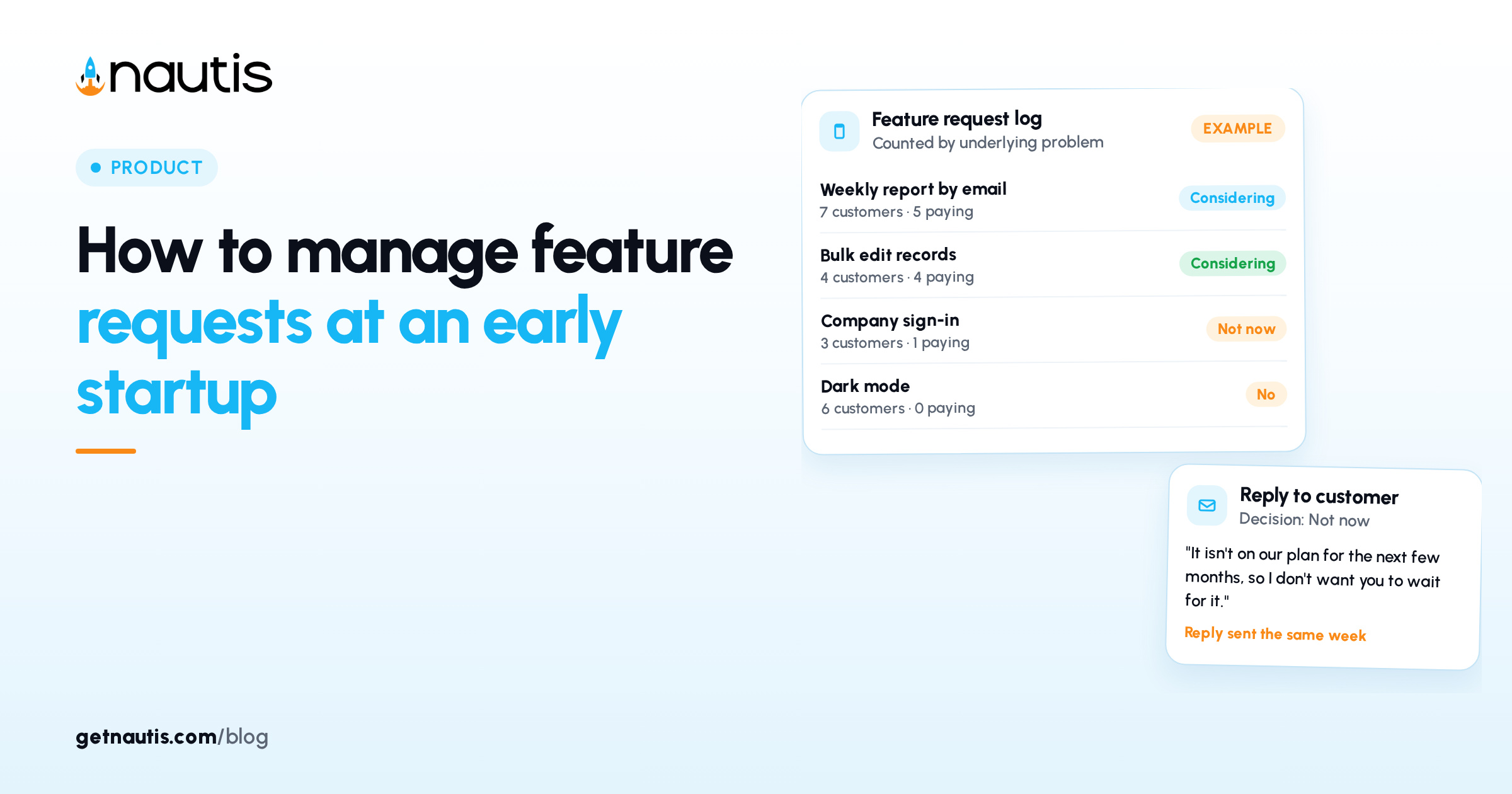
- Not now: "Thanks for explaining what you need. It isn't on our plan for the next few months, so I don't want you to wait for it. In the meantime, here's how other customers handle it."
- No: "I'll be straight with you: we've decided not to build this, because it would take the product in a direction we're not going. If it's essential, a tool built for that job will serve you better."
The "in the meantime" line matters. If there is a workaround, share it. If there is not, say so. A customer who knows where they stand can plan around it.
Review the log once a month
Once a month, block an hour with whoever decides what gets built. Sort the log by underlying problem and count how many customers are behind each one.
An example of what the count can look like after one month, with made-up figures:
Underlying problem (example) | Customers asking | Paying | Current decision |
|---|---|---|---|
Send a weekly report without logging in | 7 | 5 | Considering |
Sign in with the company's identity provider | 3 | 1 | Not now |
Bulk edit records | 4 | 4 | Considering |
Dark mode | 6 | 0 | No |
In that example, bulk editing has fewer requests than dark mode, but every request comes from a paying customer, so it deserves the closer look. Here is a simple agenda for the hour:
- Count requests by problem, and note how many come from paying customers.
- Look at any "Considering" items whose count grew since last month.
- Check whether any "No" decision needs a second look, because the reason no longer holds.
- Move at most one or two items to "Building now". Small teams that move five at once ship none of them well.
- Assign someone to reply to every customer whose request changed status.
The count is a starting point, not the answer. Ten requests from trial users who never converted may matter less than two from your best customers. For a structured way to compare the items that survive this review, score them on reach, impact, confidence and effort, as described in how to prioritize a roadmap with RICE.
Close the loop when you ship
When a requested feature ships, go back to the log and message every customer listed on that row. Name what changed and how to use it. This is the cheapest marketing a young company has, because these people already told you they wanted it.
Then mark the row as shipped with the date, so nobody contacts the same customers twice. A public record of what changed helps too. If you do not keep one yet, see how to write a product changelog.
Set up the request log in Nautis
You can run all of this in a spreadsheet. If your team already works in Nautis, these features cover the same steps:
- Custom forms. Build a feature request form with a Textarea field for the request in the customer's words, a second one for the problem they are solving, and a Select Dropdown for how often they hit it. Share the form link in your help pages or emails. Entries land on the form's Entries page, and you can export them as comma-separated values (CSV).
- Contacts. Keep each requester in your shared address book, so the person who replies can find their details and see any related leads.
- Leads CRM. For prospects whose request came up in a sales conversation, add a tag such as feature-request on the lead and write the details in its Notes tab. The customer relationship management (CRM) record then shows the request next to the deal.
- Task boards. When something moves to "Building now", create an Outcome task with an owner and due date. Use the board's Discussion tab for the build conversation, and add a final task for replying to every customer who asked.
The tools matter less than the habit. A log that is updated every week and read every month is worth more than any feature you could add to it.
Frequently asked questions
How should a small startup track feature requests?
Use one log that every channel feeds into, such as a spreadsheet or form, with fields for the customer's words, the underlying problem, who asked, their customer status, the source and the date. When the same problem comes up again, add the new customer to the existing row so you can count demand.
How do you say no to a feature request from a customer?
Say it plainly and give the reason, for example that the feature would take the product in a direction you are not going. Share a workaround if one exists, or say there is none. A clear no lets the customer plan, which a vague maybe does not.
Should you promise customers a date for a requested feature?
Only when the work is already scheduled with an owner and a target month. Otherwise, tell them the request is logged and that you will contact them if it moves forward. Vague promises are remembered and erode trust when they are not kept.
How often should a startup review its feature request list?
Once a month is enough for most teams under fifteen people. In that review, count requests by underlying problem, check which counts grew, revisit old decisions whose reasons no longer hold, and move at most one or two items into active work.
Sources
- Nautis Help Center, Custom Forms. Checked on November 13, 2026.
- Nautis Help Center, Contacts. Checked on November 13, 2026.
- Nautis Help Center, Leads and Sales CRM. Checked on November 13, 2026.
- Nautis Help Center, Task Boards. Checked on November 13, 2026.
Baltej Singh is a serial entrepreneur, technology leader, and Founder & CEO of Nautis and DemoVexa, with over 16 years of experience building software products, SaaS platforms, and startups. Previously the Co-Founder & CTO of SanchiConnect, he has worked extensively in the DeepTech startup ecosystem, connecting with 200+ venture capital firms and supporting a network of 4,000+ startups. Passionate about AI, automation, and entrepreneurship, he focuses on building innovative products that solve real-world problems and help businesses grow.