
How to write a business plan for a startup
 Baltej Singh9 min read
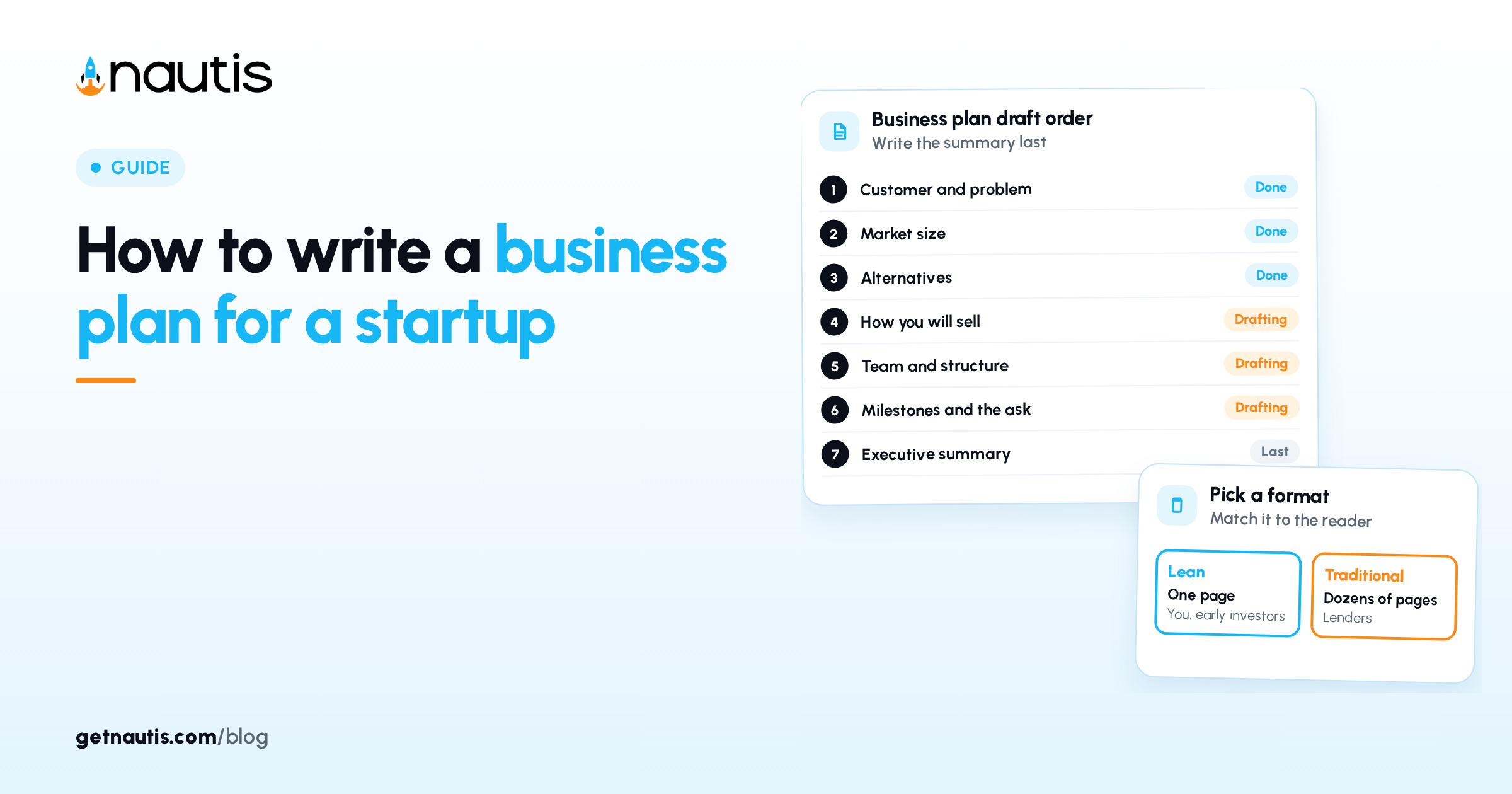
To write a business plan for a startup, decide who will read it first, pick a format that fits that reader, and then draft the sections in an order that saves rewrites: customer and problem, market, sales approach, team, numbers, and the executive summary last. A lean plan usually fits on one page. A traditional plan for a lender runs much longer and includes several years of projected financial statements.
Founders searching for how to write a business plan are rarely short on ideas. They are stuck on a template with eleven headings and no sense of which ones matter. The U.S. Small Business Administration (SBA) says it directly on its business guide: there is no right or wrong way to write one, and you should use the sections that make sense for your business.
This guide covers that choice, the drafting order, the numbers, and an example of the page most readers see first.
Who reads a startup business plan, and what do they need from it?
A business plan is read by whoever is deciding whether to give you money, time or permission. Each of those readers looks for something different, so the same document rarely serves all of them well.
Reader | What they are deciding | What they read closely | Format that usually fits |
|---|---|---|---|
Bank or loan officer | Whether you can repay | Cash flow, collateral, how the loan is used | Traditional, with statements |
Grant or accelerator reviewer | Whether you meet their criteria | Problem, team, milestones, budget | Whatever their form asks for |
Angel or seed investor | Whether the upside is large enough | Market, traction, team, the ask | Lean plan plus a pitch deck |
Co-founder or first hire | Whether to commit their next few years | Strategy, roles, runway | Lean plan |
You | What to do this quarter | Goals, costs, the next three milestones | Lean plan, updated often |
If a lender or grant program gives you a template, use theirs and skip the format debate. Early investors often ask for a pitch deck and a financial model before any long plan, so forty pages written only for them may go unread.
Traditional or lean: choosing the format before you write
The SBA describes two common formats. A traditional plan uses a standard structure, goes into detail in each section, and can run dozens of pages. The SBA notes that lenders and investors commonly request it. A lean startup plan covers only the key elements, often on a single page, and the SBA says it can take as little as an hour to make.
Here is how the two compare in practice:
Traditional plan | Lean plan | |
|---|---|---|
Length | Can be dozens of pages | Typically one page |
Typical sections | Executive summary, company description, market analysis, organization and management, product or service line, marketing and sales, funding request, financial projections | Key partnerships, key activities, key resources, value proposition, customer relationships, customer segments, channels, cost structure, revenue streams |
Financials | Projected income statement, balance sheet and cash flow, often five years | Main costs and revenue streams in a few lines |
Best for | Bank loans, some grants, formal applications | Your own planning, early investors, team alignment |
How often you revise it | When you apply for something | Monthly or quarterly |
If you are unsure, start lean. A one-page plan you trust is easy to expand later, because the hard thinking is already done.
How to write a business plan in the order that saves rewrites
Readers start with the executive summary, but you can't write it well until everything behind it exists. Work in this sequence instead.
1. The customer and the problem
Write two or three sentences on who has the problem, how they handle it today, and what that costs them. Be narrow. "Independent dental clinics with two to six chairs that still confirm appointments by phone" is usable. "Healthcare providers" is not.
2. The market
Estimate how many of those customers exist and what they could pay. Show the math rather than a single big number from a research report. Our guide to sizing your market covers top-down and bottom-up methods.
3. Competition and alternatives
List the three to five things customers use instead of you, including spreadsheets and doing nothing. For each one, write what it does well and where it leaves the customer unhappy. Note where each fact came from. A competitive analysis template helps keep these claims sourced.
4. How you will sell
Describe how a customer finds you, what happens on the first call or visit, who closes the sale, and how long that usually takes. The SBA points out that you will refer back to this section when you build projections, so the steps here should match the numbers later.
5. Team and structure
Say who does what, what each person has done before that matters here, and which roles you still need. The SBA also suggests stating the legal structure of the business, such as an LLC (limited liability company) or a C corporation. This post is not legal or tax advice, so check the structure choice with a lawyer or a CPA (certified public accountant) before you file anything.
6. Milestones and the ask
List the next three to five milestones with dates. If you are asking for funding, say how much, whether it is debt or equity, and what the money pays for over what period.
7. The executive summary
Now write the summary, using sentences you already wrote. It should stand on its own for a reader who stops after one page.
The numbers section without a finance background
The financial section is where most plans either get vague or get padded with charts nobody can trace back to an assumption. For a traditional plan, the SBA asks for projected income statements, balance sheets, cash flow statements and capital expenditure budgets for the next five years, with the first year broken down by quarter or by month. An established business also includes its past statements.
You don't need to be an accountant to build this, but you do need to write down every assumption that drives a number. Keep a short list next to the model:
- Price per customer and how you bill (monthly, annual or one-off)
- New customers per month and where they come from
- How many customers leave each month
- Each hire, its start month and its cost
- Fixed costs such as software, rent and insurance
- Any loan or funding inflow and the month it lands
Every figure in your projections should trace back to one of those lines. If a reader asks why revenue triples in year two, the answer should be a specific assumption, such as a second salesperson starting in month fourteen, and not a growth rate picked because it looked good. Our guide on how to write startup financial projections goes deeper into building base and stressed scenarios.
Match the funding request to the cash flow, so the amount you ask for covers the gap the projections show plus a buffer you can explain. Then build one cautious version where sales arrive later than you hope.
What does a good executive summary look like?
A good executive summary answers who you serve, what you sell, why now, who is building it, where you stand and what you want, in about one page. The SBA suggests it include your mission, your product or service, basic information about the team and location, and financial information and growth plans if you are asking for funding.
Here is a short, fictional example for a made-up company. The figures are illustrations, not benchmarks:
ChairTime makes appointment confirmation software for independent dental clinics with two to six chairs. These clinics lose revenue when patients miss appointments, and most still confirm by phone. ChairTime sends confirmations by text and email, lets patients reschedule from the message, and fills freed slots from a waitlist. The two founders previously ran front-desk operations for a regional dental group and built scheduling tools at a health software company. Since launching in March, ChairTime has signed 14 paying clinics at $120 a month each (example figures). We are applying for a $150,000 loan to hire one salesperson and cover twelve months of operating costs while we reach 80 clinics in two states.
That paragraph has no claims about being innovative and no market size in the billions. Each sentence could be backed up by a page further in the plan.
Before you call the summary done, check that:
- A stranger could repeat what you sell after one read
- Every number in it matches the financial section
- It states what you are asking for
- It fits on one page
Keeping the plan useful after the first draft
A plan written for one application has done its job once it is sent. A plan you run the company with needs a light routine.
Set a recurring date, monthly in the first year or quarterly later, and compare what happened against what the plan said. Update the assumptions that turned out wrong, note why, and adjust the milestones. Keep old versions, so you can see how your guesses about sales cycle length or customer losses changed.
When you apply for something new, copy the current lean plan and expand only the sections that reader cares about, using the reader table above as a guide.
Where Nautis fits when you build the plan
You can write a business plan in any document editor and a spreadsheet. If you already use Nautis, a few parts line up with the work, based on the Nautis help center:
- Financial planner builds a 3-Year Plan or 5-Year Plan projection from revenue items and model inputs. It calculates the Profit & Loss and Cash Flow tabs, has a Notes tab for documenting assumptions, and exports to Excel or to PDF (Portable Document Format). You can copy a project and use Compare to view a base case and a cautious case side by side.
- Business Profile has sections for the problem statement, solution, mission and vision, founding team, funding and use of funds, which map closely to a lean plan.
- Documents & Templates is a shared library where your team can upload and download templates as PDF, Word, Excel and PowerPoint files.
- Investor readiness lists a business plan among the signals it checks in its Team & Story category.
None of these write the plan for you. They keep the numbers, the story and the files in one place, so the version you send matches the one your co-founder edited.
Frequently asked questions
How long should a startup business plan be?
A lean plan is usually one page and covers the key elements such as customers, value proposition, channels, costs and revenue. A traditional plan for a bank loan or formal application can be dozens of pages. Match the length to what your reader asks for.
Do investors still read business plans?
Many early investors ask for a pitch deck and a financial model first, and read a longer plan only if they need more detail. A one-page lean plan is still useful as the source for the deck. If an investor or program sends you a template, use theirs.
What should go in the financial section of a business plan?
For a traditional plan, the U.S. Small Business Administration suggests projected income statements, balance sheets, cash flow statements and capital expenditure budgets for five years, with the first year by month or quarter. Established businesses also include past statements. Each projection should be explained by written assumptions.
Should I write the executive summary first?
No. The executive summary sits at the front of the plan but is easiest to write last, using sentences from the sections you already drafted. It should stand on its own for someone who reads only that page.
Sources
- U.S. Small Business Administration, Write your business plan. Checked on November 17, 2026.
- Nautis Help Center, Financial Planner. Checked on November 17, 2026.
- Nautis Help Center, Business Profile. Checked on November 17, 2026.
- Nautis Help Center, Documents & Templates. Checked on November 17, 2026.
- Nautis Help Center, Investor Readiness. Checked on November 17, 2026.
Baltej Singh is a serial entrepreneur, technology leader, and Founder & CEO of Nautis and DemoVexa, with over 16 years of experience building software products, SaaS platforms, and startups. Previously the Co-Founder & CTO of SanchiConnect, he has worked extensively in the DeepTech startup ecosystem, connecting with 200+ venture capital firms and supporting a network of 4,000+ startups. Passionate about AI, automation, and entrepreneurship, he focuses on building innovative products that solve real-world problems and help businesses grow.