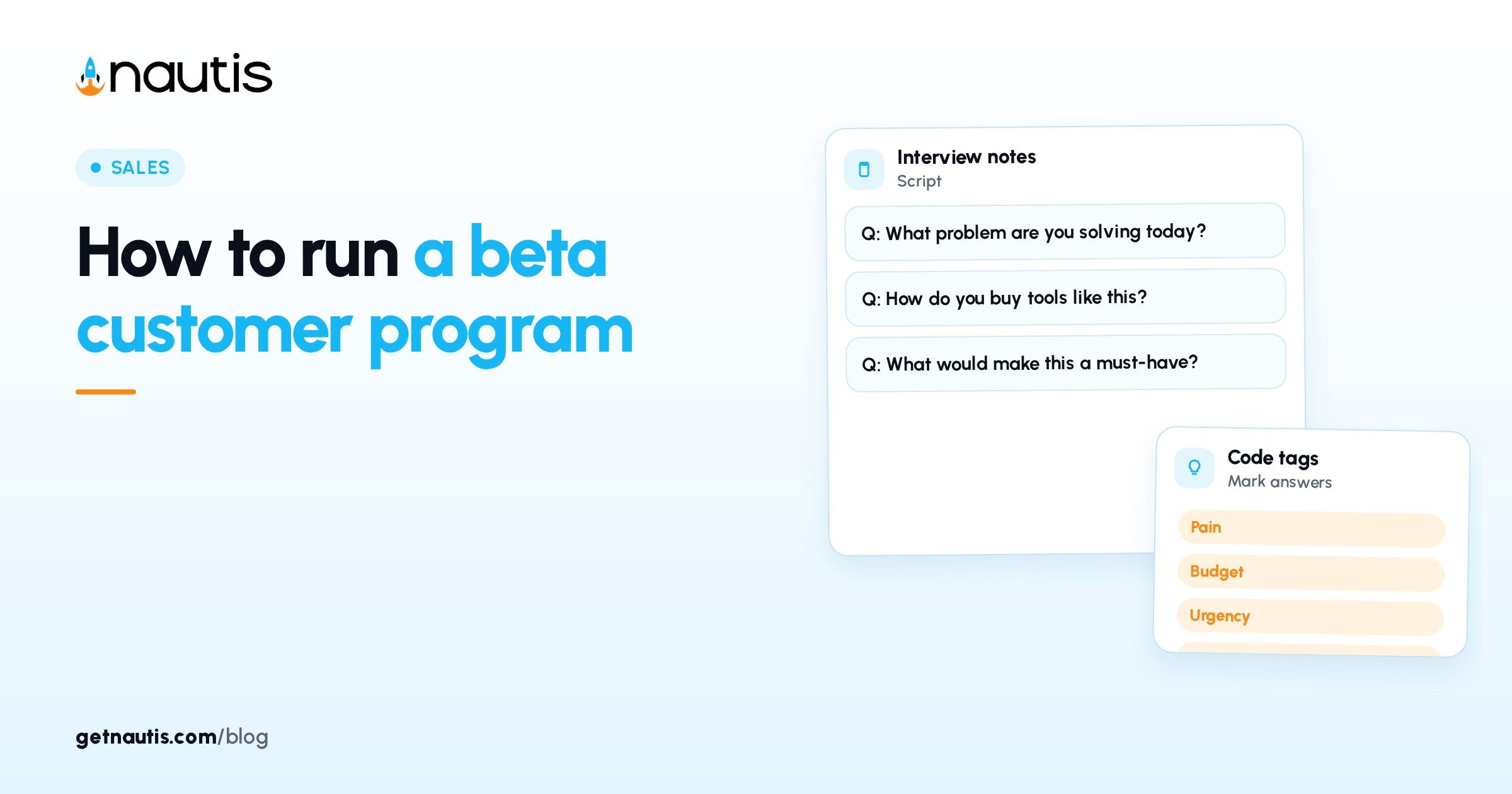
How to run a beta customer program
 Baltej Singh8 min read
A beta customer program is a small, invited group of real buyers who use an unfinished product under written rules and send structured feedback on a fixed cadence. It is not a public waitlist, not a substitute for customer discovery before you have a point of view. The goal is evidence that changes the product weekly, not a vanity count of logos on a slide.
Founders often blur beta with launch marketing. They open a form to anyone with an email, promise "early access," and then drown in support noise from people outside the ideal customer profile (ICP). Y Combinator's essential startup advice keeps returning to talking with users and doing work that does not scale. A tight beta is that advice with a roster and a calendar.
Who belongs in a beta customer program
Invite people who already feel the problem you claim to solve and who can put the product into a real workflow within two weeks. Prefer operators with budget influence over friendly advisors who will never buy. Five to fifteen active accounts is enough for most seed-stage B2B tools. Larger groups hide patterns.
Write an invite rule before you send the first note:
- ICP match (role, company size or motion, trigger event)
- Willingness to meet weekly or biweekly for a fixed window
- Ability to try the product on real work, not a sandbox toy account only
- Permission to quote anonymized feedback in internal notes
Exclude anyone who only wants a discount, anyone outside the ICP "just to be nice," and anyone who cannot name a workflow they will touch in the first fourteen days.
Cap stretch invites. One stretch account can teach edge cases. Three stretch accounts usually pull the roadmap toward buyers you will not serve this year. Write the stretch reason on the CRM card so future you remembers why the exception existed.
Example invite filter (illustrative)
You sell scheduling software to clinic ops managers. Your beta rule might require an ops owner at a clinic with at least two front-desk staff, a current tool they dislike, and a thirty-minute weekly call for six weeks. Friends who run SaaS companies do not qualify under that rule even if they are warm.
Write access rules before the first login
Beta chaos usually comes from unclear expectations, not from buggy software. Put the rules in one page the invitee must accept:
- What works today and what is explicitly unfinished
- How to report bugs (one channel, one template)
- How often you will ship fixes visible to them
- Whether pricing later will honor a beta discount (state it or say pricing is undecided)
- Confidentiality: what they may share publicly
- Exit: how either side ends the beta
Say "14-day trial" only if you mean Nautis-style product trial language elsewhere. For your own beta, say "beta access window" with start and end dates. Do not promise unpaid access with no end date if that is not your real offer.
If you collect applications, a short Custom Forms page can capture role, company, problem statement, and willingness to meet. Nautis Custom Forms supports fields, a public Live URL, and entry review. You can also collect the same fields in a spreadsheet. Either way, review entries on a cadence instead of accepting every submission the hour it arrives.
Share the rules in the same channel you use for invites so nobody digs through email threads. If a participant asks for a feature outside the written scope, point back to the page and log the request as input for Friday, not as an emergency build.
Run a weekly feedback loop that forces decisions
A beta without a decision loop becomes a support queue. Fix the cadence before kickoff.
Weekly rhythm (example)
Day | Owner | Job |
|---|---|---|
Monday | Founder | Send a three-question pulse to active beta accounts |
Tuesday to Thursday | Founder or builder | Ship one visible fix or clarification tied to last week's themes |
Friday | Founder | Thirty-minute synthesis: keep, change, or drop product bets |
Pulse questions that work early:
- What did you try to do this week that failed or felt slow?
- What almost made you stop using the product?
- What would make next week obviously better?
Record answers in Notes or any shared doc tagged by account. Patterns beat isolated quotes. After five accounts repeat a friction, it is a product decision, not a support ticket.
Log the bigger product bets in writing. In Nautis, Decision Loop can hold title, category, confidence, expected outcome, and a 30, 60, or 90 day review date. A plain decision journal works the same way if that is all you have.
When two founders share the beta, split the jobs: one owns the pulse and synthesis, the other owns the visible weekly ship. Mixing both jobs into "whoever has time" is how Fridays arrive with no synthesis and a longer bug list.
Keep beta accounts visible in your CRM
Treat beta seats as tracked relationships, not a hidden email list. In Nautis, Leads & Sales CRM (shown as Leads & CRM in the sidebar) holds pipelines, stages, tags, and notes for commercial leads. Create a pipeline or tag set that marks beta status so nobody confuses a beta account with a fully paying customer or a cold lead.
Minimum fields to keep current (use tags and notes if your CRM is thin):
- Account and primary contact
- ICP fit (yes / stretch / no)
- Access start date and planned end date
- Last feedback date
- Top open friction
- Commercial intent (exploring, likely buy, unlikely)
Contacts can store people separately when you need a durable directory. Keep hygiene light but weekly. A beta roster that lives only in a founder's inbox will drop people and double-book calls.
For application intake that is not yet a sales deal, you can keep Custom Forms Entries as the queue and promote accepted applicants into the CRM the day you grant access. That handoff is a named chore with an owner.
If sales and product share one pipeline view, add a stage or tag that means "beta active" and another that means "beta exited." Without that, a hopeful AE may quote full pricing language while product still expects patience on unfinished paths.
Measure learning, not logo count
Count the wrong thing and you will expand the beta for theater. Prefer these measures during the window:
Measure | Why it matters | Example target shape |
|---|---|---|
Active weekly usage | Proves the workflow is real | Share of invited accounts with a meaningful action each week (set your own floor) |
Time to first value | Shows onboarding truth | Median days from access to first successful job-to-be-done |
Repeated frictions | Drives the roadmap | Top three frictions by account count, updated Friday |
Commercial signal | Separates users from buyers | Number of accounts that ask about paid terms unprompted |
Founder hours in support | Guards capacity | Hours spent unblocking beta users each week |
All numbers above are shapes, not benchmarks. Replace them with your own floors before week one. If active usage is thin, shrink the roster or fix onboarding before you invite more people. Growing a quiet beta only multiplies silence.
Publish the Friday synthesis where builders look on Monday. A private founder note that never reaches the people writing code cannot change the product. Three bullets and one decision are enough.
When the product is closer to launch messaging, you may also run a separate waitlist launch for a new product. Keep that list distinct from the beta roster. Waitlist demand and beta learning answer different questions.
End the beta on purpose
Every beta needs an end date or an exit review. Open-ended betas become unpaid consulting with no pricing conversation.
Exit options to write in advance:
- Convert to paid on stated terms
- Extend beta by a short, dated window with a new learning goal
- Graduate to a design-partner contract with clearer obligations
- Thank them and revoke access when fit is wrong
Hold a thirty-minute exit call. Ask what almost blocked conversion, what must exist for them to pay, and whether they will take a reference call later. Capture wins and losses with the same discipline you would use in a win-loss interview.
After exit, update the CRM stage, archive the beta tag, and move recurring feedback into ordinary customer success habits. Early customer success for early SaaS starts with a named owner and a first-thirty-days map; beta graduates should land in that map on day one of paid access.
A one-sitting beta setup checklist
Use this when you have a half day to stand the program up.
- Write the ICP invite rule and the maximum roster size.
- Draft the access rules page and the bug report template.
- Build the application form (Custom Forms or equivalent) with only fields you will read.
- Create the CRM pipeline or tags for beta status.
- Schedule the weekly pulse and the Friday synthesis on real calendars.
- Pick three learning measures and who updates them.
- Write the exit options and the planned end date.
- Send the first five invites only after steps 1 to 7 exist in links you can share.
A beta customer program earns its keep when Friday's synthesis changes next week's build list. If feedback never alters the roadmap, you are hosting a tour, not a beta. Keep the roster small, the rules written, the CRM current, and the end date visible. That is enough structure for an early team and light enough that customers will still tell you the truth.
Frequently asked questions
How many customers should be in a beta?
Most seed-stage B2B teams learn faster with five to fifteen active accounts than with a large open group. Keep stretch invites rare and labeled. If weekly usage is thin, shrink the roster before you grow it.
How is a beta different from a waitlist?
A waitlist measures demand and sequences access. A beta gives a small invited group hands-on product time with a feedback cadence. Keep the two lists separate so marketing demand does not bury product learning.
What should beta participants agree to?
They should see what works, what is unfinished, how to report bugs, how often you will ship visible fixes, what they may share publicly, and how either side ends the beta. Write those rules on one page before invites go out.
When should a beta end?
Set an end date or exit review when you start. Convert to paid, extend with a new learning goal, move to a design-partner contract, or revoke access when fit is wrong. Open-ended betas turn into unpaid consulting.
Sources
- Y Combinator, YC's Essential Startup Advice. Checked on November 2, 2026.
- Nautis Help Center, Custom Forms. Checked on November 2, 2026.
- Nautis Help Center, Leads & Sales CRM. Checked on November 2, 2026.
Baltej Singh is a serial entrepreneur, technology leader, and Founder & CEO of Nautis and DemoVexa, with over 16 years of experience building software products, SaaS platforms, and startups. Previously the Co-Founder & CTO of SanchiConnect, he has worked extensively in the DeepTech startup ecosystem, connecting with 200+ venture capital firms and supporting a network of 4,000+ startups. Passionate about AI, automation, and entrepreneurship, he focuses on building innovative products that solve real-world problems and help businesses grow.