How to run customer discovery calls
 Baltej Singh8 min read
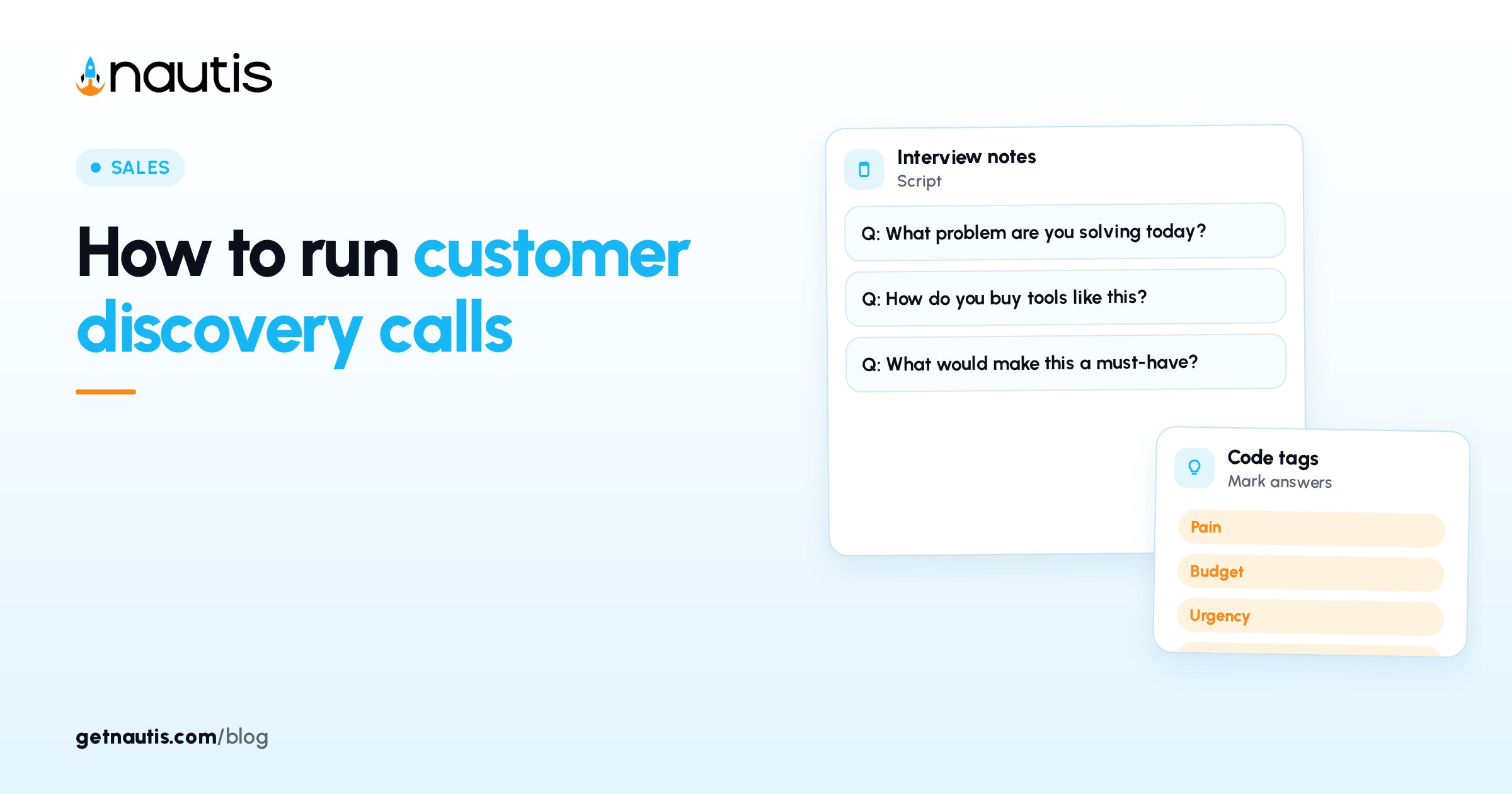
Customer discovery calls are short, structured conversations with people who feel the pain you think you solve. How to run customer discovery calls well means you leave with a clear problem statement, not a polite reaction to your pitch. Recruit real buyers, ask for stories, and stop selling until the pattern is boringly clear.
Keep the first five calls on one ICP slice. Change the script only after you can predict the answers.
What customer discovery calls are for before you buy ads
The job of customer discovery calls is to learn how buyers describe the problem, what they already tried, and what would make them switch. Ads and launch tactics come after that picture is stable.
YC essential startup advice favors talking to users and focusing on real demand over process theater (Y Combinator Library, checkedOn 2026-11-01). Treat discovery the same way: fewer polished decks, more honest transcripts.
Illustrative miss (composite only): twenty demos with a slide pitch; zero notes on current workflow; "interest" logged without a next step or a problem quote.
Illustrative win (composite only): eight calls in two weeks; six quotes about the same manual handoff; one competitor named in five of eight; script frozen for the next batch.
If a call does not change what you believe about the buyer, change who you recruit or what you ask. Repeating the same soft compliments is not learning.
Write one sentence before each call: the claim you are testing. Example: "Ops leads at 20-person B2B SaaS teams still reconcile invoices in spreadsheets every Friday."
If you cannot write that sentence, you are not ready to book. Spend a day on ICP drafts and sample questions first.
Who to recruit and what to promise
Recruit people who match the job title, company size, and workflow you plan to sell into first. Warm intros beat cold lists. Offer a clear time box and a plain reason: you are learning how they handle X today, not pitching a product.
Illustrative recruit (composite only): ten intros from two advisors; six booked; four complete; titles match ICP; two declined because they do not own the workflow.
Promise a 25- or 30-minute call, a short agenda, and that you will not ask them to buy. If you need a longer deep dive later, book it as a separate meeting after you earn the right.
Skip friends who will be kind instead of specific. Skip people outside the ICP "for practice." Practice on the ICP or you will optimize for the wrong pain.
Confirm the workflow owner is on the call. A curious teammate who does not own the process will give opinions; the owner will give calendars, tools, and costs.
Send a short brief the day before: three topics, the time box, and how notes will be used. Respect their time and they will give sharper stories.
Record who referred them and why you think they match. That referral context often explains unusual answers without forcing a bad ICP stretch.
How to structure the call so each part ends with an answer
Use a fixed sequence so you do not slide into a pitch. Leave each part of the call only when you can say a concrete answer out loud, not when the clock feels awkward.
Call part | Minutes | Move on when you can say |
|---|---|---|
Context | 3 | Who they are, what they own, and the workflow under discussion |
Current process | 8 | The steps they take today, tools named, and where time or money leaks |
Last painful incident | 6 | A dated story with trigger, cost, and who else was involved |
What they tried | 5 | Alternatives, workarounds, and why those failed or stalled |
Ideal outcome | 4 | What "fixed" looks like in their words, with a measurable hint |
Close | 2 | Permission to follow up, intro ask if earned, thanks |
Illustrative handoff (composite only): after "last painful incident," you can quote "Friday reconcile took four hours and missed a vendor payment"; only then move to what they tried.
If they ask for a demo mid-call, park it: finish the story sections first, then offer a separate product walkthrough later. Discovery that becomes a demo early trains you to sell features instead of hearing pain.
Keep questions open. Prefer "Walk me through the last time this broke" over "Would you use a tool that does X?"
Name tools and systems the way the buyer names them. Translating into your product language too early hides whether they already pay for a partial fix.
When silence appears, wait. People fill silence with the real workaround. Jumping in with your hypothesis teaches them to agree with you.
Capture notes so patterns survive the day
Memory flattens quotes within hours. Write during the call or immediately after. Store problem language in the buyer's words, not your marketing paraphrase.
In Nautis, open Notes from Profile & Company. Click Add Note. Set the title with the company and date, then Save. Type / for headings and lists. Put tags such as discovery, ICP slice, and call number (max 20 tags). Use Note settings for an Executive summary, status (Draft, Published, or Archived), and Shared access for teammates who need the raw quotes. Click Save again for a "Note saved" confirmation. Pin notes you will reuse in the next script rewrite.
Illustrative note (composite only): title "Acme ops discovery 2026-11-01"; tags discovery, ops-lead, mid-market; body with five verbatim quotes and one open question.
Creating notes needs create rights; editing needs write rights. New notes are private to you until you share them. Prefer Archive over Delete if you might need the quote later; deleted notes are gone for good.
Optional: put discovery notes in a folder such as Discovery / ICP-A so filters stay clean. Folders are shared organization-wide; folder names cannot contain "/". Deleting a folder never deletes notes.
If a transcription tool is connected to Meetings, you can Copy the formatted transcript from the meeting details into a Note so the summary and action items sit next to your own quotes. Still rewrite the problem line in the buyer's language; transcripts alone are not a pattern library.
Book the next call without calendar chaos
A discovery pipeline dies when booking is a DM scavenger hunt. Publish one event type for discovery and reuse it.
In Nautis Meetings under Profile & Company, set an Availability Schedule (New Schedule, weekly hours, Save Changes). Create an Event Type such as "30 Minute Discovery Call" with Duration 30, your schedule, a Location Type, Minimum Notice, and buffers. Click Create. Copy the booking URL from the event type or from Share & Links for the full booking page. Creating event types needs create permission on Meetings.
Illustrative booking (composite only): event type "Discovery 30"; buffer 10 minutes after; minimum notice 240 minutes; six slots filled in a week without founder DM tennis.
For one-off calls that cannot use the link, click New Meeting, add Title, Date, Start time, Duration, Location, and Attendees, then Create. Invitees do not need a Nautis account to book through the public page.
Do not invent a second scheduling product in email. One link, one duration, one follow-up note template.
Cap yourself at two discovery event types at most (for example, a 30-minute first call and a 45-minute deep dive). More types recreate the chaos you just removed.
After each call, send a short thank-you with one clarifying question only if a fact was ambiguous. Do not attach a pitch deck unless they asked for a separate product conversation.
Turn five calls into one clear buyer claim
After five complete calls, stop and synthesize. Count repeated problem phrases, tools, and triggers. Write one ICP claim you would defend to a skeptical cofounder.
Illustrative synthesis (composite only): five of five mention Friday reconcile; four name the same spreadsheet; three tried a generic automation and quit after setup time; claim locked for the next ten calls.
Feed the claim into your go-to-market picture when you are ready. In GTM Planner under Strategy & Planning, a workspace Strategy tab holds Ideal Customer Profile, Positioning, Value Stack, Messaging, Risks, and Competitor Analysis. Edit those sections from real quotes, or use Builder for a first draft you then correct by hand. Shared Access controls who can open the workspace; GTM permission is required. Do not invent ICP text that no call supports.
If calls disagree wildly, your recruit filter is too broad. Narrow title, company size, or workflow before you book more time.
Illustrative narrow (composite only): "ops leads" became "ops leads who close books monthly without a full-time controller"; the next four calls rhymed.
Measure success by whether a stranger can read your Notes folder and restate the problem without watching a pitch. Quote density beats call count.
Before the first call of a batch, read the last three notes aloud. If you cannot hear a shared phrase, your questions are still wandering or your recruit filter is still mixed.
When the claim is stable, change the script only to probe the next uncertainty (budget owner, switch trigger, or must-have outcome). Keep the same timed parts; swap the test sentence at the top.
Stop booking discovery on that slice when you can predict the painful incident section before they speak. Move to solution interviews or a paid pilot design only after that bar is met.
Plan limits for Notes, Meetings, and GTM Planner appear in-product; see pricing for plan context.
Frequently asked questions
How long should a customer discovery call be?
Twenty-five to thirty minutes with a written section plan. Longer deep dives become a separate meeting after you earn them.
Should I demo during discovery?
Not in the middle of story sections. Finish process and painful-incident questions first; offer a product walkthrough as a follow-up if they ask.
How many calls before I change the product?
Synthesize after five complete calls on one ICP slice. Change the offer only when quotes rhyme or when a clear gap repeats.
Where should I store discovery notes in Nautis?
In Notes under Profile & Company. Use Add Note, tags, optional folders, and Shared access for teammates who need raw quotes.
Sources
- Y Combinator, Essential startup advice. Checked on November 1, 2026.
- Nautis Help Center, Notes. Checked on November 1, 2026.
- Nautis Help Center, Meetings. Checked on November 1, 2026.
- Nautis Help Center, GTM Planner. Checked on November 1, 2026.
Baltej Singh is a serial entrepreneur, technology leader, and Founder & CEO of Nautis and DemoVexa, with over 16 years of experience building software products, SaaS platforms, and startups. Previously the Co-Founder & CTO of SanchiConnect, he has worked extensively in the DeepTech startup ecosystem, connecting with 200+ venture capital firms and supporting a network of 4,000+ startups. Passionate about AI, automation, and entrepreneurship, he focuses on building innovative products that solve real-world problems and help businesses grow.