A solo founder operating cadence that fits one week
 Baltej Singh8 min read
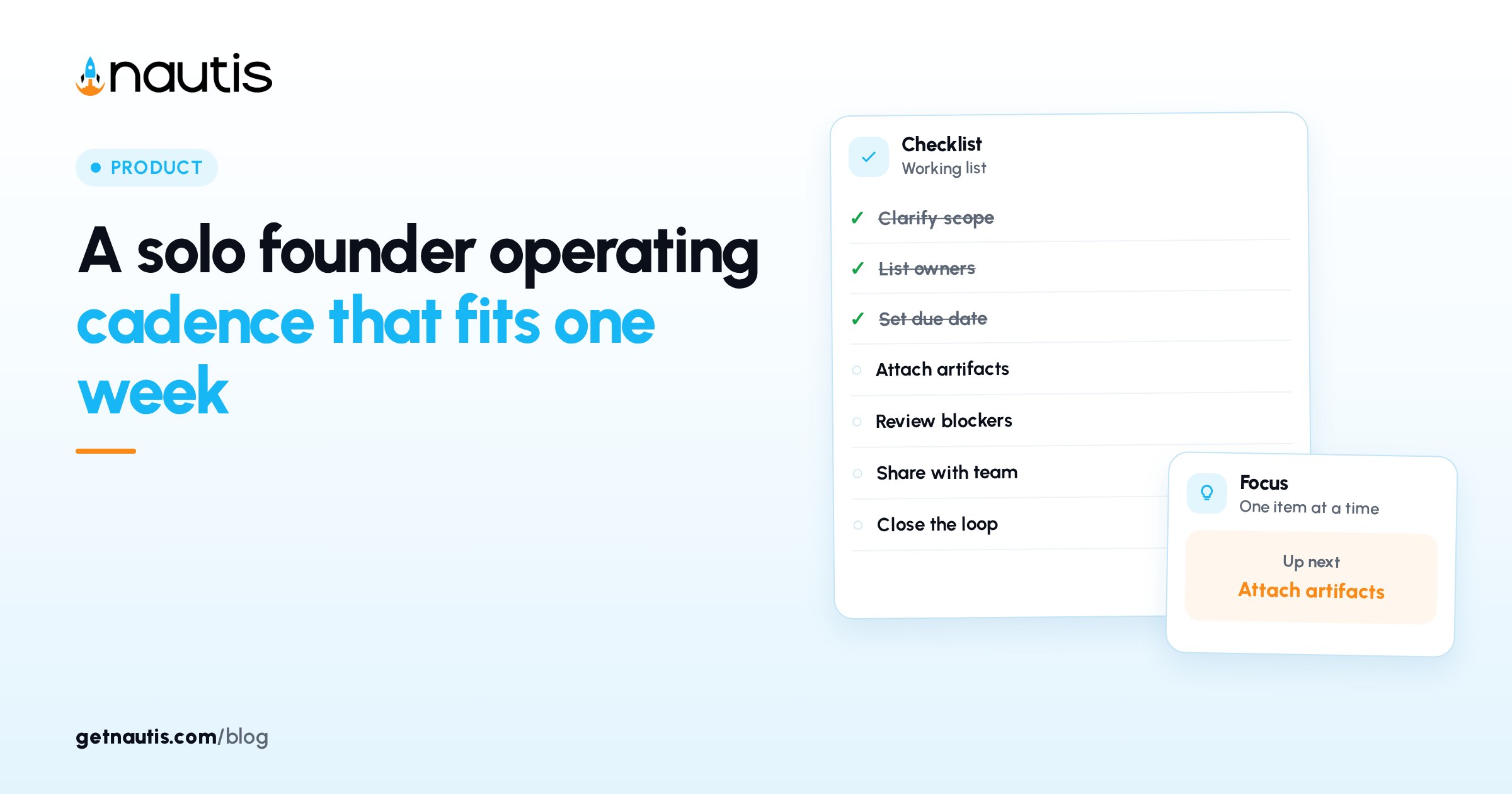
A solo founder operating cadence is a short weekly rhythm you can keep without a chief of staff on payroll. It is not a longer to-do list and it is not a stage essay about how CEOs should spend time at Series A. It is three anchors in one week: choose outcomes on Monday, tell the truth about pipeline midweek, and write cash, MRR, and burn before the weekend. Keep each anchor short enough that you still run it when you are tired.
What a solo founder operating cadence is for
Solo founders lose weeks inside reactive chat. A cadence puts the same three checks on the calendar so product work still gets long blocks. The goal is repeatability, not theater.
Illustrative promise (composite only): "Ninety minutes a week across three anchors, then back to building and customer calls."
Pair the cadence with stage context from Founder's day by stage when you wonder whether you are over-operating for pre-seed. This post stays on the weekly skeleton, not on hiring plans or board theater.
Write the cadence on one page. If it needs a wiki, it will die by Thursday.
Three weekly anchors beat seven daily vows
Daily vows sound disciplined and collapse first. Three anchors survive.
Anchor | When | Open | Done when |
|---|---|---|---|
Outcomes | Monday morning | Task boards or a single outcomes note | Three outcomes named for the week, each with a finish line |
Pipeline | Wednesday | Leads CRM pipeline | Stages updated, next actions dated, dead leads parked |
Cash truth | Friday or month-end fringe | Startup Health check-in fields | Cash Balance, Monthly MRR, and Monthly Burn entered or confirmed |
Illustrative calendar (composite only): Monday 9:00 outcomes for 25 minutes; Wednesday 11:00 pipeline for 30 minutes; Friday 16:00 cash for 20 minutes. Month ends that fall midweek still get a Startup Health pass that day instead of waiting for Friday. The weekday labels are defaults, not religion.
Protect builder blocks around the anchors. Do not sprinkle five micro-check-ins that recreate a fake team standup for one person. Treat sleep and one protected deep-work block as part of the operating system, not as rewards after the anchors. A cadence that only schedules admin will still leave the product stuck.
Monday: name outcomes with a finish line
Open Task boards or a single note if that is all you trust. Pick at most three outcomes for the week. Each needs a finish line a stranger could verify: shipped, sent, booked, or decided.
Illustrative outcomes (composite only): "Ship billing retry email"; "Book four discovery calls"; "Decide yes or no on the agency pilot."
Park everything else on a someday list. Solo cadence fails when Monday becomes a hundred-card grooming session. Twenty-five minutes is enough to choose; more time usually means fear of choosing. Name the finish line in the card title when you can. "Billing retry email live in production" beats "billing work." Future-you on Friday should not need a decoder ring.
Solo cadence also needs a explicit non-goal list for the week. Write two things you will not work on even if Slack begs. Without non-goals, the three outcomes lose to whoever messaged last.
If a Decision Loop item is blocking an outcome, open Decision Loop, log the question and options, and set a decide-by date inside the week. Do not carry vague "think about pricing" cards that never close.
End Monday by blocking the calendar for the deep work those outcomes need. A cadence without calendar blocks is a wish list.
Midweek: pipeline truth without a sales team
Open Leads CRM. This is the sales CRM for customers and commercial leads, separate from Fundraising CRM. Drag leads through your stages so the board matches reality. Live numbers on pipeline value and movement only help if stages are honest.
Illustrative midweek pass (composite only): move two stale "demo done" leads to a parked stage with a reason; set next-step dates on three active leads; add one new lead from last week's calls.
Ask three questions:
- Which lead can close or learn something this week?
- Which lead is polite fiction?
- Which conversation am I avoiding because it might be a no?
Write the answers in a single line under the board. Solo founders skip this and then wonder why month-end revenue surprises them. Photograph or export nothing fancy. A honest board with fewer leads beats a decorated funnel that hides ghosts. If a lead has had no touch in three weeks and no next date, it is fiction until you touch it or park it.
When customer support is still on you, fold a ten-minute triage into Wednesday after pipeline, not as a fourth sacred ritual. Answer what blocks revenue or learning; batch the rest.
Keep Fundraising CRM off this anchor unless you are in an active raise week. Mixing investor conversations into the commercial pipeline muddies both.
If you have no leads yet, use the same slot for customer conversations: schedule or complete discovery calls and log notes. The cadence still holds; the object is learning, not a fake funnel.
Friday: cash, MRR, and burn without drama
Open Finance, then Startup Health. The module is a monthly check-in for Cash Balance, Monthly MRR, and Monthly Burn, turned into runway and trend views. Solo cadence uses Friday to either enter the month-end numbers or confirm you are ready to enter them on the first of the month.
Click Update Data to open Monthly Founder Check-in. Choose This month or Other month. Enter Cash Balance from the last bank day of the month, Monthly MRR as recurring revenue only, and Monthly Burn as spend minus revenue (or 0 if cash-flow positive). Copy last month when only a few fields changed. Save & Update Dashboard refreshes the hero cards for Cash Balance, Monthly MRR, Monthly Burn, and Runway.
Illustrative Friday (composite only): bank export open, Cash Balance typed, MRR matches the subscription list, Burn excludes a one-off hardware purchase from MRR math. MRR must stay recurring-only. One-off project cash belongs in Cash Balance stories, not in Monthly MRR, or growth percentages will thrash and teach you the wrong lesson.
Do not invent daily cash rituals that you will skip. Consistency across months makes History and Analytics useful. If you skip Friday because travel wrecked the day, keep the month-end capture. Other month in the check-in dialog exists so a missed Friday does not erase the trend chart. Put a backup invite on the first weekday of the new month. For runway math background, see How to calculate startup burn rate.
If alerts mention low runway or negative MRR growth, write one sentence about what changes next week. Do not rebuild the company in the check-in dialog.
Investor Snapshot Editor can wait until after Save if you owe backers a narrative. Solo cadence cares first that the three numbers exist.
Keep the rituals short enough to run alone
Time-box each anchor and stop when the box ends. Leftover cards move to next week instead of stealing builder hours.
Illustrative hard stops (composite only): Monday ends when three outcomes are written; Wednesday ends when every active lead has a next date or a parked reason; Friday ends when the three Startup Health fields are saved or explicitly deferred to month-end day one with a calendar invite.
Refuse new recurring meetings that only exist to make the cadence feel "real." Solo operating cadence is private discipline. Add a weekly team meeting later when there is a team; that is a different post.
Review the one-pager every fourth week. Cut any step you skipped three times. Replace it with a smaller step or delete it. Cadence that exists only on Notion is not cadence. Share the one-pager with a cofounder or advisor only if they will hold you to the three anchors. Audience without accountability becomes performance.
Adjust anchors when the company stage shifts
Pre-seed days should stay heavy on building and customer conversations, with light operations. Seed pulls more time into founder-led sales, so the Wednesday pipeline anchor earns more minutes while Monday outcomes stay product-aware. Later stages add managers and meetings; do not copy those calendars while you are still solo.
Illustrative shift (composite only): after the tenth paying customer, Wednesday expands from twenty to forty minutes; Friday stays twenty because the Startup Health fields did not get more complex.
When you are no longer solo, keep the same three truths (outcomes, pipeline, cash) but share ownership. Until then, the solo founder operating cadence is yours to run, shorten, and defend against fake busywork.
Put the three anchors on the calendar tomorrow. Run them once without upgrading tools mid-week. Improve the one-pager after a full week, not after a single awkward Monday. When an anchor repeatedly overruns, shrink the scope before you add tools. Longer checklists are how solo weeks quietly become management theater without a team.
Keep phone-away rules for the Monday and Friday blocks if chat is how you abandon the cadence. Pipeline midweek can stay nearer to the inbox because the work is conversational.
Frequently asked questions
What is a solo founder operating cadence?
A short weekly rhythm with Monday outcomes, a midweek pipeline pass, and a Friday or month-end cash check. It protects builder time instead of adding empty meetings.
Do I need a daily briefing product to run this?
No. This cadence stands on Task boards or a note, Leads CRM, and Startup Health. Use other morning tools only if they help you hit the three anchors.
What numbers go into Startup Health?
Cash Balance at month end, Monthly MRR for recurring revenue only, and Monthly Burn as spend minus revenue (or 0 if cash-flow positive). Save & Update Dashboard refreshes runway views.
How is Leads CRM different from Fundraising CRM?
Leads CRM is the sales CRM for customers and commercial leads. Fundraising CRM tracks investors. Keep investor chats out of the Wednesday commercial pipeline pass.
Sources
- Nautis Startup Health help. Checked on October 31, 2026.
- Nautis Leads CRM help. Checked on October 31, 2026.
- Founder's day by stage. Checked on October 31, 2026.
- How to calculate startup burn rate. Checked on October 31, 2026.
Baltej Singh is a serial entrepreneur, technology leader, and Founder & CEO of Nautis and DemoVexa, with over 16 years of experience building software products, SaaS platforms, and startups. Previously the Co-Founder & CTO of SanchiConnect, he has worked extensively in the DeepTech startup ecosystem, connecting with 200+ venture capital firms and supporting a network of 4,000+ startups. Passionate about AI, automation, and entrepreneurship, he focuses on building innovative products that solve real-world problems and help businesses grow.