How to set a founder salary without guesswork
 Baltej Singh8 min read
Founder salary benchmarks approach means picking a cash number from written comparables and assumptions, not from mood or a single tweeted screenshot. Nautis does not sell a salary benchmark database. Employee Management lets you set compensation, run payroll, and keep history once you choose a number: open a profile, use Compensation, click Add revision, enter Annual CTC, and save. The benchmark work still happens in a Note or sheet you refresh monthly. This is operating guidance. It is not tax, employment, or legal advice. Use counsel and a CPA for entity rules, reasonable compensation, and payroll taxes.
Write the definition before you chase comps
A founder salary benchmarks approach fails when salary means different things to each co-founder. Write one definition at the top of the artifact:
- Cash paid this year (base), before or after benefits you will name.
- Whether equity refreshes are in or out of this decision.
- Currency and pay frequency.
- Who is covered (each founder named).
Illustrative Northwind definition (composite only): "Founder salary means monthly cash base in USD, paid through payroll, excluding health stipend and excluding option grants. Applies to Ada and Ben equally unless the board Note says otherwise."
Cut anything you cannot measure. If you cannot say whether a car allowance counts, it does not belong in the definition until you decide.
Build a small comps table, then haircut it
Start with published stage or survey figures you can link, then apply haircuts for your company. Do not paste a rumor as a market fact.
Published anchor (checked 31 Oct 2026) | What the source states | How you might haircut it (illustrative) |
|---|---|---|
Kruze Consulting 2026 Startup CEO Salary Report | Seed-stage CEO average $153,000; typical Seed range $130,000-$170,000 from anonymized US VC-backed payroll clients | Illustrative: if your seed is thinner or runway shorter, work the low end of that range, not the average |
Kruze Consulting 2026 report | Series A CEO average $203,000; typical range $180,000-$230,000 | Illustrative: ignore Series A rows until you have matching traction; they are not seed comps |
Pilot Founder Salary Report 2025 | Survey of 1,844 founders; median founder salary $75,000; 60% paid themselves less than $100,000 | Illustrative: use as a broad survey floor signal, not a stage-matched CEO payroll average |
Cite every published row in Sources. Any company-specific pick below is illustrative only.
Illustrative Northwind math (composite only, not a market claim): they treat Kruze Seed mid-$100Ks as an upper reference, note Pilot's lower survey median as a caution that many founders pay less, haircut for their own runway, and land on an illustrative $108,000 equal founder cash figure with assumptions dated in the sheet.
List assumptions underneath the chosen number. Examples: "Two founders, same cash. No secondary. Sources: Kruze 2026 Seed average and range; Pilot 2025 median. Review in 90 days."
Reject screenshots without stage labels. A Series B figure is not a seed benchmark. Require stage, geo, year, and URL on every published row or delete the row.
Separate lifestyle floor from market band
Your personal burn is a floor constraint, not a market proof. Write it on a separate line: rent, food, debt minimums, dependents. If the floor sits above the band your company can afford after citing comps, you have a financing or lifestyle problem, not a missing survey.
Illustrative miss (composite only): a founder copies a late-stage screenshot with no citation, skips haircuts, and sets cash far above what runway allows. A clean founder salary benchmarks approach would have shown the published Seed range, the haircut, and the floor gap in writing.
Board or lead investor conversations go better when you show cited anchors, haircuts, floor, and pick as separate lines.
Sources that usually help versus sources that mislead
Helpful: dated payroll or large survey reports with method notes (for example Kruze payroll aggregates and Pilot's founder survey), recruiter ranges that name stage, CPA or counsel notes on reasonable compensation for your entity, and peers who share cash bands with context you can write down.
Misleading: anonymous screenshots, mixing Series C packages into seed decisions, market rate claims with no geography or year, and blending cash-plus-equity into a cash salary cell.
When a source disagrees with your pick, update the assumption list or discard the source. Do not leave contradictory published numbers unmarked. A founder salary benchmarks approach that preserves every rumor will always look like guesswork.
International founders: convert published comps to one currency for the sheet, and note local net-versus-gross differences as assumptions. Employee Management Annual CTC should match the gross figure payroll will use.
If you are pre-revenue, weight runway and lifestyle floor more than peer cash flex. Cited ceilings still do not obligate you to fill them.
Enter the pick in Employee Management
When the pick is final, put it in Employee Management. From Human Resources, open Employee Management. On the employee profile, open Compensation, click Add revision (or Edit), choose Revision type (new for the first one, then revision or promotion later), enter Annual CTC, adjust Basic % and HRA % if your plan uses those splits, add allowances and deductions as needed, and Save. Compensation history stays on the profile.
If payroll runs elsewhere, still keep the same Annual CTC and effective date in a shared Note so the benchmark artifact and the pay system cannot drift.
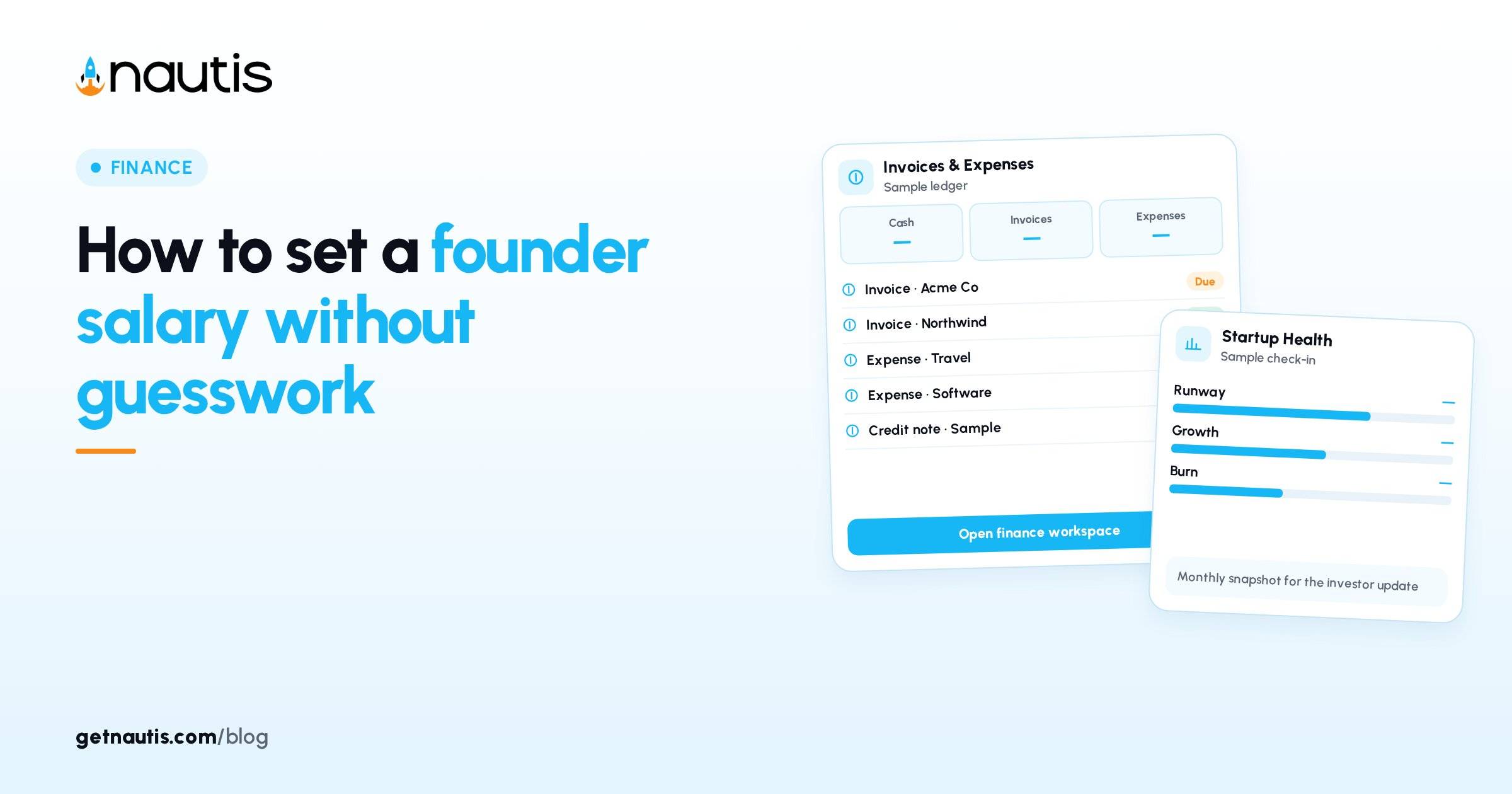
Startup Health cash and burn check-ins should reflect the new payroll load the month it starts. A salary change that never shows up in burn math is incomplete.
Share the artifact with whoever can unblock payroll changes. A number that only lives in a founder chat will not reach Compensation on time.
Before you lock the number, read the assumptions aloud with every paid founder present. If someone cannot repeat the definition and the top haircut reason, the artifact is not done. After the first payroll cycle on the new Annual CTC, reconcile one pay stub to the sheet.
Founder salary benchmarks approach: refresh monthly
Calendar a short monthly pass:
- Confirm definition unchanged.
- Note any new cited comp (or mark no new comps) with links.
- Recompute whether runway still tolerates the pick given current burn.
- Keep or schedule a revision; do not silent-raise.
Monthly boredom is the point. Equal co-founders should refresh on the same cadence even if one wants a freeze. Asymmetry needs a dated board or co-founder Note.
Illustrative monthly line (composite only): "2026-06-01: still using Kruze 2026 Seed range as upper reference; no new survey; burn +4% from hire; keep illustrative $108,000; next review after Q3 revenue gate."
Illustrative unequal case (composite only): Ada takes $100,000 and Ben takes $120,000 because Ben relocated with board acknowledgment dated in the Note. Both numbers sit inside a band framed by cited Seed references after haircuts. Without the Note, history gets rewritten from memory.
When you revise later, use Add revision again so history stays intact.
Illustrative six-week setup
Illustrative Northwind (composite only): Week 1: write definition; list lifestyle floors separately. Week 2: paste Kruze and Pilot figures with URLs; fill haircut column. Week 3: pick an illustrative number; list assumptions; align co-founders. Week 4: Add revision in Employee Management; update burn outlook. Week 5: tell the CPA effective date; confirm withholdings. Week 6: first monthly refresh with no new comps.
Cash salary stays on the benchmark artifact. Equity stays on Cap Table conversations.
Board updates: attach the one-page artifact with source links when compensation changes. Co-founder onboarding later: hand the same definition, cited anchors, and band; amend with a dated revision.
What benchmarks cannot do
Cited benchmarks cannot bless an unaffordable number. They cannot replace counsel on reasonable compensation for your entity type. They cannot settle a co-founder dispute about effort without a separate roles agreement.
If fundraising advice pushes take less than the cited band, write that discount as an assumption with an end date. Founder salary benchmarks approach should show the discount and when you will revisit it.
For burn and runway labels when you test affordability, see How to calculate startup burn rate and runway. For planning tools around the wider model, see Best startup financial planning tools for founders.
Close the loop in writing
Keep one written definition, list assumptions underneath, and refresh monthly. When someone asks how you set pay, hand them the artifact: definition, comps table with citations and haircuts, floor line, pick (labeled illustrative if not yet paid), assumptions, last refresh date.
Treat the monthly refresh as a standing calendar event owned by one founder. After three missed months, rebuild the comps table from scratch because stale haircuts are how guesswork returns.
Keep CPA feedback in the same artifact as a dated note. A founder salary benchmarks approach stays honest when objections sit next to the pick before Compensation gets an Add revision.
A founder salary benchmarks approach is finished when a teammate can recompute your band from the sheet and open the source links without asking what salary meant.
If advisors disagree wildly on the same cited row, widen the band and pick with a written reason, or drop the weaker method note. Three solid cited rows beat twelve rumors.
Frequently asked questions
Does Nautis provide salary benchmarks?
No. Gather published comps externally and cite them. Employee Management stores compensation once you choose a number.
How do I save the chosen Annual CTC in Nautis?
In Employee Management, open the profile, go to Compensation, click Add revision, enter Annual CTC, adjust splits if used, then Save.
How often should we revisit cited comps?
Monthly: confirm the definition, add or skip new linked sources, check runway tolerance, keep or schedule a revision.
Can co-founders take different cash amounts?
Yes if you document why under the same definition and a band framed by cited anchors. Put asymmetry in a dated Note.
Sources
- Kruze Consulting 2026 Startup CEO Salary Report. Checked on October 31, 2026.
- Pilot Founder Salary Report 2025. Checked on October 31, 2026.
- Pilot 2025 Founder Salary Report press summary. Checked on October 31, 2026.
- Nautis Employee Management help. Checked on October 31, 2026.
- How to calculate startup burn rate and runway. Checked on October 31, 2026.
Baltej Singh is a serial entrepreneur, technology leader, and Founder & CEO of Nautis and DemoVexa, with over 16 years of experience building software products, SaaS platforms, and startups. Previously the Co-Founder & CTO of SanchiConnect, he has worked extensively in the DeepTech startup ecosystem, connecting with 200+ venture capital firms and supporting a network of 4,000+ startups. Passionate about AI, automation, and entrepreneurship, he focuses on building innovative products that solve real-world problems and help businesses grow.