How to write a customer case study for a B2B startup
 Baltej Singh9 min read
A customer case study is a short, skimable story that shows how a named customer solved a real problem with your product and what changed afterward. If you need how to write a customer case study that sales can send, pick one customer with a clear before and after, run a focused interview, draft seven sections with approved quotes and measured results, then get written sign-off before anything goes public.
This guide is for early B2B startups that already have a few customers using the product in production. It is not legal advice. Customer quotes and results claims are a form of advertising under United States Federal Trade Commission (FTC) rules, so have counsel review anything you publish when you are unsure.
When is a customer ready for a case study?
Wait until the customer has a real result you can describe without guessing. A logo on a slide is not a case study. A case study needs a problem, a decision, a rollout, and at least one outcome the customer will stand behind in writing.
Signal | Ready | Not ready |
|---|---|---|
Time on product | They finished a real rollout window | They are still in a pilot with no outcome |
Result | They can name a before and after metric or a concrete operational change | They only say “we like it” |
Champion | Someone will sit for a 30 to 45 minute interview | Only a friendly contact who cannot speak for the company |
Risk | Legal or marketing will review a draft | They forbid any public mention |
Fit | Their industry and size match buyers you want next | The story only helps a niche you do not sell to |
If the account is still shaky, invest in customer success basics first. A weak story hurts more than silence.
How to pick the right customer without guessing
Score candidates on evidence, not on who replies fastest. A simple scorecard keeps the sales team honest.
Criterion | 0 | 1 | 2 |
|---|---|---|---|
Problem clarity | Vague “needed better tools” | Named workflow that was broken | Named workflow plus a cost (time, errors, or missed deals) |
Result strength | Soft praise only | One directional change | Before and after with how it was measured |
Buyer resemblance | Unlike your ideal customer | Close on industry or size | Matches the segment you are selling now |
Quote quality | Will not go on record | Will approve a paraphrase | Will approve a named quote and title |
Timeline | Cannot place when things changed | Approximate quarter | Clear dates for before, go-live, and after |
Add the scores. Prioritize the highest total that also matches the deal type you want to win next. Ask once, in writing, for permission to interview and to publish a draft subject to their review. Do not start drafting from memory of a kickoff call.
The interview that feeds the draft
Book 30 to 45 minutes with the champion and, when possible, one user who lives in the workflow. Send the agenda one day ahead so they can pull reports. Record only with consent, and say how the recording will be used. Use a fixed question bank so you do not forget metrics.
Before the call, pull your own timeline: close date, go-live date, seats provisioned, and any support tickets tied to the rollout. That prep stops you from asking the customer to remember dates you already have, and it flags gaps you still need them to fill.
Section you need | Ask | Capture |
|---|---|---|
Challenge | What was happening before you looked for help? What did that cost? | Trigger, cost, who felt it |
Decision | What else did you compare, and why did you choose us? | Alternatives and decision criteria |
Rollout | What did the first 30 to 90 days look like? What was harder than expected? | Owners, timeline, friction |
Results | Which numbers moved, from what to what, over which period, from which report? | Metric, baseline, after, source |
Quote | What would you tell a peer who is where you were a year ago? | One or two lines in their words |
Limits | Is there anything we should not mention? | Logo rules, numbers to hide, competitor names |
Write the notes the same day in Notes: customer name, interview date, raw quotes, metric table, and open questions. Tag the note “case-study” and share it with whoever will draft. If you still owe a metric, put a dated task on the owner instead of inventing a number.
How to write a customer case study section by section
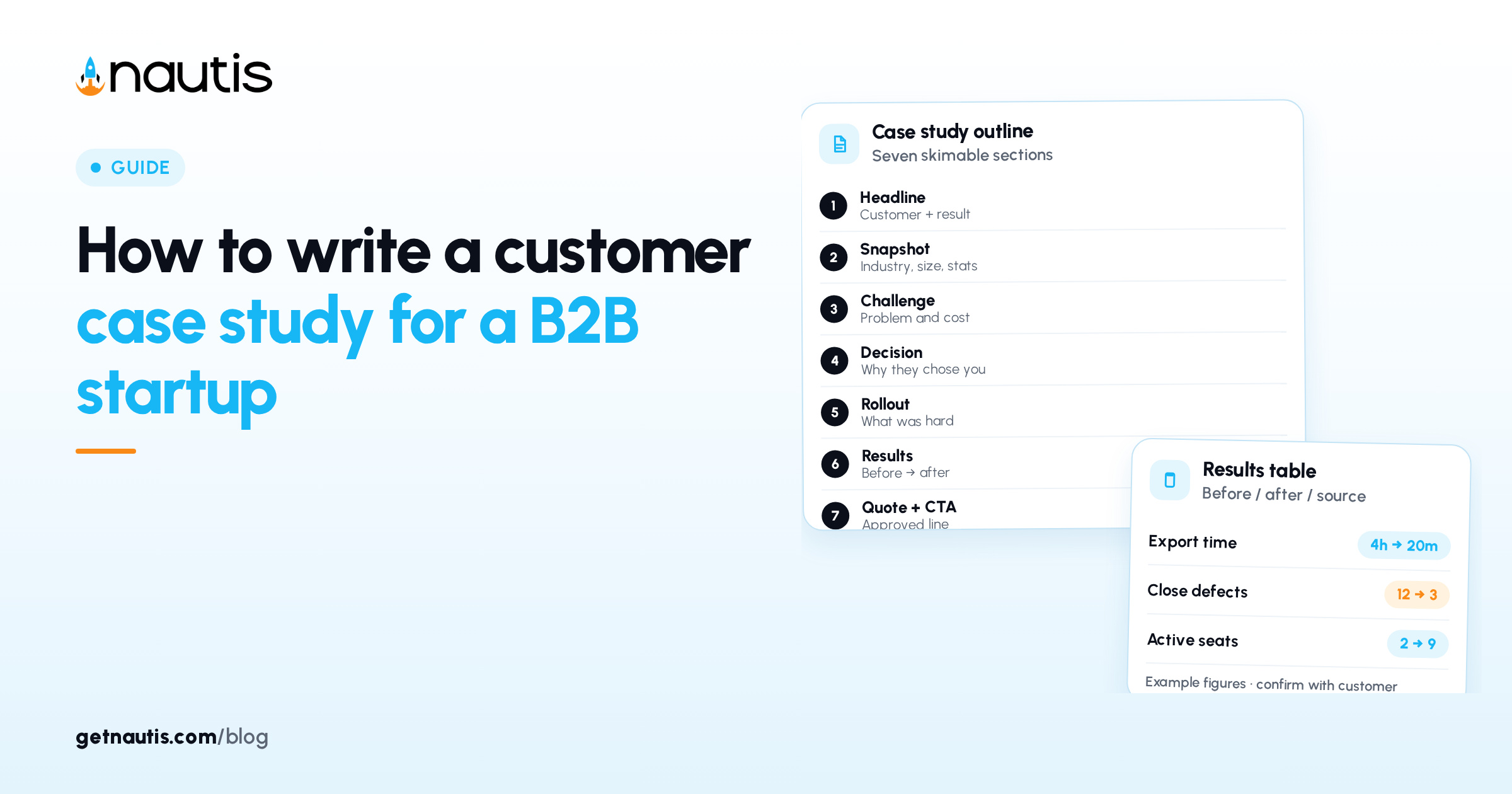
Keep the public story short enough to skim. Many B2B case studies land around several hundred to about a thousand words; let the evidence set the length, not a filler target. Use this order every time so readers and search engines see the same shape.
Section | Job | Typical length |
|---|---|---|
Headline | Customer plus outcome plus time window | One line |
Snapshot | Industry, size, product used, two or three headline stats | Five to seven lines |
Challenge | Problem and cost in their words | About 100 to 150 words |
Why they chose you | Alternatives and decision | About 75 to 125 words |
Rollout | What they did and what was hard | About 100 to 150 words |
Results | Before, after, measurement method | Table plus a short paragraph |
Quote and next step | Approved line plus one call to action | A few sentences |
Draft rules that keep the story honest
- Put the result in the headline. “Northline cut invoice export time from four hours to 20 minutes in six weeks” beats “Northline customer story.”
- Write the challenge in the customer’s language. Keep your feature names out until the rollout section.
- In results, every number needs a before value, an after value, a unit, a time window, and a source (for example, “from their billing export for July vs October”). If any piece is missing, leave the number out or label it clearly as an example the customer still needs to confirm.
- Include one difficulty in the rollout. Perfect stories feel fake.
- End with one next step for the reader, such as a link to a sales proposal template your team uses or a demo booking page.
Example results table (label every figure as an example until the customer confirms it):
Metric (example) | Before | After | Window | Source |
|---|---|---|---|---|
Weekly invoice export time | 4 hours | 20 minutes | Six weeks after go-live | Ops manager time log |
Month-end close defects | 12 tickets | 3 tickets | Same two months year over year | Support queue tag |
Seats actively using the workflow | 2 | 9 | Day 60 | Product admin list |
How should you handle quotes, logos, and results claims?
Under the FTC’s Guides Concerning the Use of Endorsements and Testimonials in Advertising (16 CFR Part 255), an endorsement must reflect the honest opinions and experience of the endorser, and you may not use a testimonial to make a claim you could not substantiate if you said it yourself. If a story implies that the endorser’s results are typical, you need a reasonable basis for that implication, or you need to disclose what consumers can generally expect. “Results not typical” alone is not a safe fix.
Practical checklist before publish:
- Written approval of the final text, quotes, title lines, and logo use
- Confirmation the spokesperson still stands by the quote
- Every performance number tied to a source and a date range
- No invented logos, titles, or metrics
- Clear disclosure if the customer received extra discount, services, or other material value in exchange for the story
- Counsel or compliance review when the claim is aggressive, health related, financial, or likely to be read as typical for all buyers
Send the draft for signature through DocSign when your organization uses it, or through whatever contract process your counsel prefers. Keep the approved PDF with the note so a later rewrite does not drift from what they signed.
Publish formats sales will actually use
One story can feed three assets without rewriting the facts:
Format | Length | Best use |
|---|---|---|
Web page | Full seven sections | SEO and long evaluation cycles |
One-page PDF | Headline, snapshot, three bullets per section, results table | Email attachment and late-stage deals |
Slide (two to three cards) | Snapshot plus one quote plus one metric | Live demos and webinars |
Do not let marketing publish a different number than sales quotes on calls. The approved note is the source of truth. Put the public URL on the opportunity record and in the proposal template so every rep links the same version.
When the customer expands usage, schedule a refresh rather than silently updating a live page. A refresh needs a new interview or a short written update, plus a fresh approval of any changed numbers or quotes. Retire the old PDF when the new one ships so prospects do not compare conflicting figures.
Keep a steady pipeline of stories
A single case study goes stale. Run a light operating cadence:
- After each successful rollout, the owner of the account scores the customer on the table above within one week.
- Marketing or the founder books the interview within two weeks of a “ready” score.
- Draft within five business days of the interview; approval within ten.
- Publish only after sign-off; then add the link to the proposal template and the CRM record.
Assign owners so the cadence does not depend on one person’s memory:
Step | Owner | Done when |
|---|---|---|
Score the account | Account owner | Scorecard filled within one week of a successful rollout |
Book and run the interview | Founder or marketing | Notes and raw quotes saved the same day |
Draft and send for approval | Writer | Customer has the full draft, not a vague outline |
Publish and wire into sales | Marketing plus sales lead | URL live, PDF attached to the proposal template, CRM field updated |
In Nautis, keep candidates on Leads CRM or Contacts with a “case-study-candidate” tag, store interview notes in Notes, track drafting and approval tasks on a Task Board, and hold the signed release in DocSign or a data room folder your team already uses. The Chief of Staff can surface overdue approval tasks in the Briefing when those tools are part of your workspace. The writing still has to stay boringly accurate: one customer, one problem, one measured change, one approved quote.
Frequently asked questions
How long should a B2B customer case study be?
Long enough to cover challenge, decision, rollout, and measured results without filler. Many teams keep the public story to several hundred words up to about a thousand, and cut a one-page PDF from the same facts.
Do I need the customer’s permission to publish a case study?
Yes. Get written approval of the final text, quotes, title lines, and logo use before anything goes public, and keep that approval with the draft.
What metrics belong in a customer case study?
Only numbers with a before value, an after value, a unit, a time window, and a source the customer confirms. If any piece is missing, leave the number out or label it as an example still awaiting confirmation.
Are customer quotes regulated in the United States?
Customer endorsements used in advertising are covered by the FTC’s endorsement guides. The quote must reflect the person’s honest experience, and you cannot use it to make a claim you could not substantiate yourself. Check with counsel when you are unsure.
Sources
- 16 CFR Part 255, Guides Concerning the Use of Endorsements and Testimonials in Advertising (GovInfo). Checked on November 20, 2026.
- Federal Register, Guides Concerning the Use of Endorsements and Testimonials in Advertising (2023). Checked on November 20, 2026.
- Nautis Help Center, Notes. Checked on November 20, 2026.
- Nautis Help Center, DocSign. Checked on November 20, 2026.
Baltej Singh is a serial entrepreneur, technology leader, and Founder & CEO of Nautis and DemoVexa, with over 16 years of experience building software products, SaaS platforms, and startups. Previously the Co-Founder & CTO of SanchiConnect, he has worked extensively in the DeepTech startup ecosystem, connecting with 200+ venture capital firms and supporting a network of 4,000+ startups. Passionate about AI, automation, and entrepreneurship, he focuses on building innovative products that solve real-world problems and help businesses grow.