How to write a sales proposal for a B2B deal
 Baltej Singh9 min read
If you want to know how to write a sales proposal that closes a business-to-business (B2B) deal, start from the buyer's own words, not your product. A good proposal restates the problem the buyer described, offers one recommended scope with a clear price, names what success looks like, and ends with a dated next step. Keep it to two or three pages so the person you spoke with can forward it to whoever signs.
Many early founders write proposals the way they write pitch decks: company history first, features second, price buried on page eight. The buyer then has to translate all of that into a story their boss will accept. This guide shows a structure that does the translating for them, with a worked example you can copy.
When is a deal ready for a proposal?
A deal is ready for a proposal when the buyer has told you the problem, the person who decides, and a rough budget range. Without those three, a proposal is a guess dressed up as a document, and it tends to sit unread.
Before you open a blank page, check that you can answer each of these from your call notes:
- What problem did the buyer describe, in the words they used?
- What happens if they do nothing for another six months?
- Who signs, and who else has to agree before that person signs?
- What budget range came up, even loosely?
- What date or event is pushing them to decide now?
If two or more answers are blank, don't write the proposal yet. Send a short recap email instead that lists what you heard and asks for a second call with the person who signs. That email does more for the deal than a polished document sent to the wrong reader.
A proposal also isn't the place to handle open objections. If the buyer pushed back on price or security during the call, settle that in conversation first. The guide to objection handling for early product demos covers how to answer those in the room.
What goes into a sales proposal
Every section has one job. If a section doesn't help the buyer decide, cut it.
Section | What it says | Rough length |
|---|---|---|
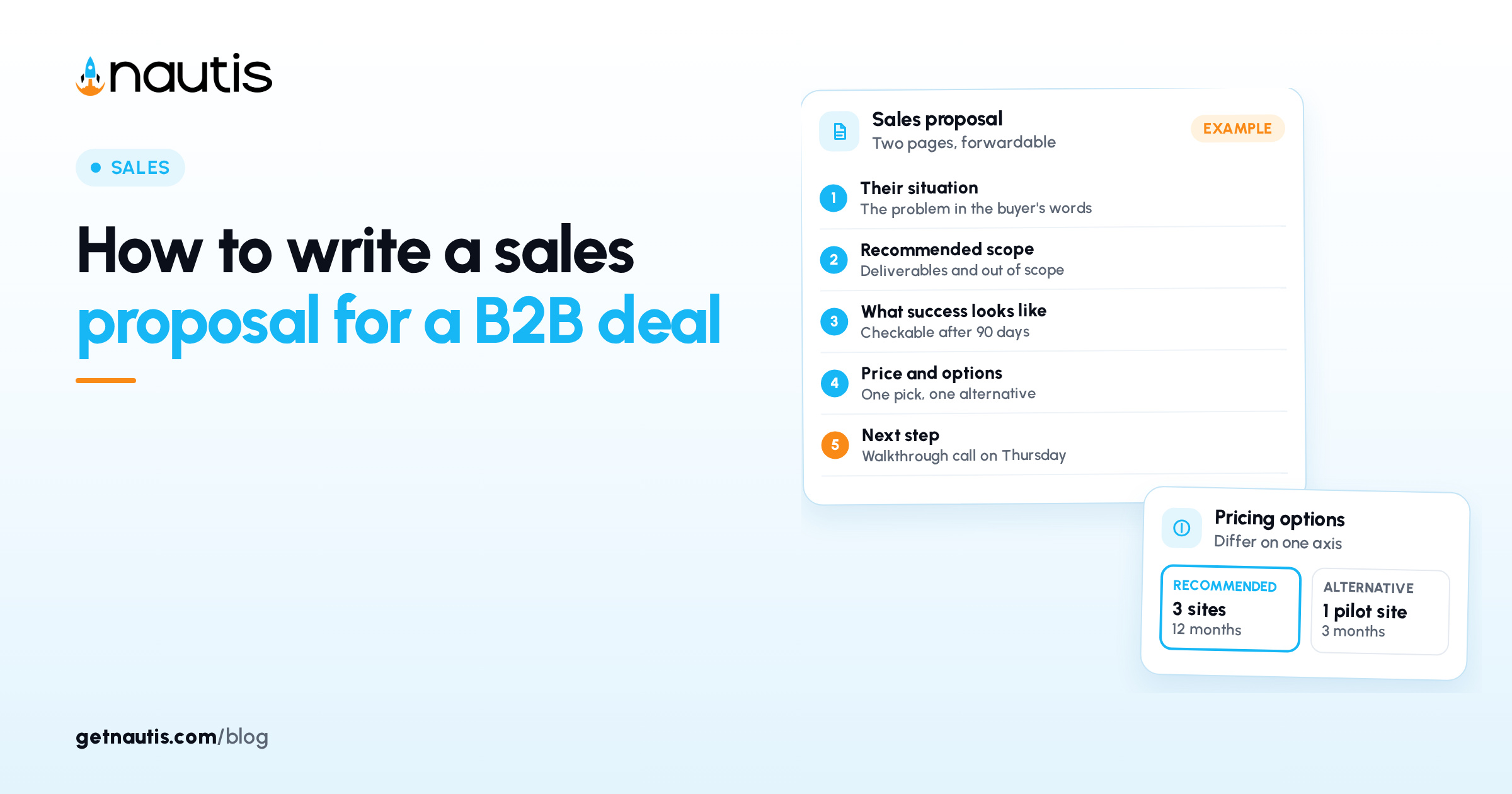
Their situation | The problem in the buyer's words, and what it costs them today | One short paragraph |
Recommended scope | What you will deliver, and what is out of scope | Five to eight bullets |
What success looks like | Two or three outcomes the buyer can check after 90 days | Three bullets |
Price and options | One recommended option, plus at most one alternative | A small table |
Timeline | Start date, key milestones, who does what | Four to six rows |
Next step | The single action and the date you agreed | One or two sentences |
Terms | Payment terms, contract length, how either side can end it | A short list or a linked order form |
Notice what isn't on the list: your founding story, your full feature list, a page of logos. If the buyer needs background on your company, a single line with a link to your site is enough.
How to write a sales proposal the buyer can forward
The person you talked to is rarely the only reader. They will forward your proposal to a manager, a finance lead or a co-founder who never heard your pitch. Write every section so that reader understands it cold.
Open with their situation, not your company
Start with two or three sentences that restate the problem as the buyer told it. Use their numbers if they gave you any, and label them as theirs. "Your team told us that onboarding a new warehouse site takes about three weeks of spreadsheet work" is far stronger than "Our platform streamlines operations."
If the reader nods at the first paragraph, they keep reading. If it sounds like a brochure, they skim to the price.
Write scope as deliverables, not features
List what the buyer gets, phrased as outcomes they can see. "Weekly stock report sent to each site manager every Monday" beats "Automated reporting module." Then add a short out-of-scope list. Saying what you won't do protects you from scope creep and shows the buyer you listened.
Define success the buyer can check
Pick two or three outcomes the buyer can measure without your help. Tie each one to the problem in the opening paragraph. Avoid promising a result you can't control, such as revenue growth. Promise the things your work directly changes, such as setup time or the number of manual steps.
Put the price where it can be found
Don't hide the price. A reader who has to hunt for it assumes the worst. Give the total, what it covers, and how it is billed.
End with one next step and a date
The last section should ask for one thing: a call to walk through the proposal, a signature on an order form, or a security review. Name the date you both agreed on during the call. "We'll hold the March start date until Friday the 14th" gives the buyer a reason to act without sounding pushy.
How many pricing options should a proposal show?
Show one recommended option, and at most one alternative. Three or more options turn a yes-or-no decision into a comparison project, and comparison projects get postponed.
The alternative should differ on one clear axis, such as scope or contract length, so the buyer can choose quickly. Here is an example for an imaginary 15-person logistics company. All figures are example figures for illustration, not benchmarks.
Recommended | Alternative | |
|---|---|---|
Scope | Three warehouse sites, weekly reports, setup support | One pilot site, weekly reports |
Term | 12 months | 3 months, then decide |
Price (example) | $1,200 per month | $500 per month |
Setup (example) | Included | $750 one-time |
Best if | You already know all three sites need it | You want proof at one site first |
The "Best if" row does the selling. It tells the buyer which option fits which situation, so they can pick without another call. If you find yourself adding a third column, ask whether the buyer actually raised that option. If they didn't, leave it out.
When the buyer asks for a discount, trade it for something rather than giving it away. A lower monthly price for a longer term, or a smaller scope for a smaller price, keeps the proposal consistent. A bare discount teaches the buyer that your first number wasn't real.
A one-page proposal for an example deal
Here is how the structure reads when filled in. The company, people and figures are invented for illustration.
Dana runs a 4-person startup that sells scheduling software to logistics companies. She had a discovery call with Leon, the operations lead at an example 15-person freight company. Leon said his team spends most of each Monday rebuilding driver schedules in spreadsheets after weekend changes. His manager, the chief operating officer (COO), signs anything over a set monthly amount. They want a fix before their busy season starts in March.
Dana's proposal fits on one page and a half:
- Your situation. Leon's team rebuilds driver schedules by hand each Monday, which delays route assignments until the afternoon. Busy season starts in March, when weekend changes roughly double, according to Leon.
- Recommended scope. Import of current driver and route data, a shared schedule that updates when a driver swaps a shift, and a Monday summary for the COO. Out of scope: billing, route optimization, and customer-facing tracking.
- What success looks like. Monday schedules finished by 10 a.m., shift swaps recorded without a spreadsheet, and one place the COO can check coverage.
- Price. The two-column table above, with the recommended option first.
- Timeline. Data import in week one, team training in week two, live by the first week of February.
- Next step. A 20-minute call with Leon and the COO on Thursday to confirm scope, then an order form for signature.
Every line points back to something Leon said. That is what lets him forward it to the COO without adding a cover note.
Sending the proposal and following up
How you send a proposal matters almost as much as what is in it.
Walk it through live
Where you can, book a short call and walk through the proposal on screen rather than emailing it cold. You hear objections while you can still answer them, and the buyer's manager can ask questions directly. Send the document right after the call, with a two-line note restating the agreed next step.
Track where each proposal sits
Move the deal into a proposal stage in whatever pipeline you use, and set the expected close date you discussed. If your stages are still loose, the guide to sales pipeline stages for early startups shows how to define them by evidence.
In Nautis, the customer relationship management (CRM) module, Leads & CRM, lets you add a stage named "Proposal" through Manage Pipeline Stages, set an Expected Close Date on the lead, and attach the proposal file in the lead's Files tab. If you draft the proposal in Notes, the share dialog can create a public link and shows how many times each share has been viewed. When the buyer is ready to sign, DocSign sends a Portable Document Format (PDF) order form for e-signature, with a signing order and an Expiry (days) setting for the link.
Follow up on the date you agreed
Follow up once, on the date you set together, not every two days. If the buyer goes quiet past that date, send one short note asking whether the timing has changed. A clear "not now" lets you plan, which is worth more than a deal that stays open for months. For more on running early deals yourself, see the founder-led sales playbook.
Frequently asked questions
How long should a sales proposal be?
Two or three pages is enough for most early B2B deals. Each section should help the buyer decide, so leave out company history and full feature lists. If the buyer needs background, add one line with a link to your site.
Should I include pricing in a sales proposal?
Yes. State the total, what it covers and how it is billed, in a place the reader can find quickly. Buyers who have to hunt for the price tend to assume the worst, and the person who signs will look for it first.
How many options should a sales proposal include?
Include one recommended option and at most one alternative. Make the alternative differ on one axis, such as scope or contract length, and add a line saying which situation each option fits. More options turn a yes-or-no decision into a comparison that often gets postponed.
When should I send a sales proposal instead of a recap email?
Send a proposal once you know the problem, who signs and a rough budget range. If two or more of those are missing, send a short recap email listing what you heard and ask for a call with the person who signs.
Sources
- Nautis Help Center, Leads and Sales CRM. Checked on November 14, 2026.
- Nautis Help Center, DocSign. Checked on November 14, 2026.
- Nautis Help Center, Notes. Checked on November 14, 2026.
Baltej Singh is a serial entrepreneur, technology leader, and Founder & CEO of Nautis and DemoVexa, with over 16 years of experience building software products, SaaS platforms, and startups. Previously the Co-Founder & CTO of SanchiConnect, he has worked extensively in the DeepTech startup ecosystem, connecting with 200+ venture capital firms and supporting a network of 4,000+ startups. Passionate about AI, automation, and entrepreneurship, he focuses on building innovative products that solve real-world problems and help businesses grow.