When your startup should hire a bookkeeper
 Baltej Singh8 min read
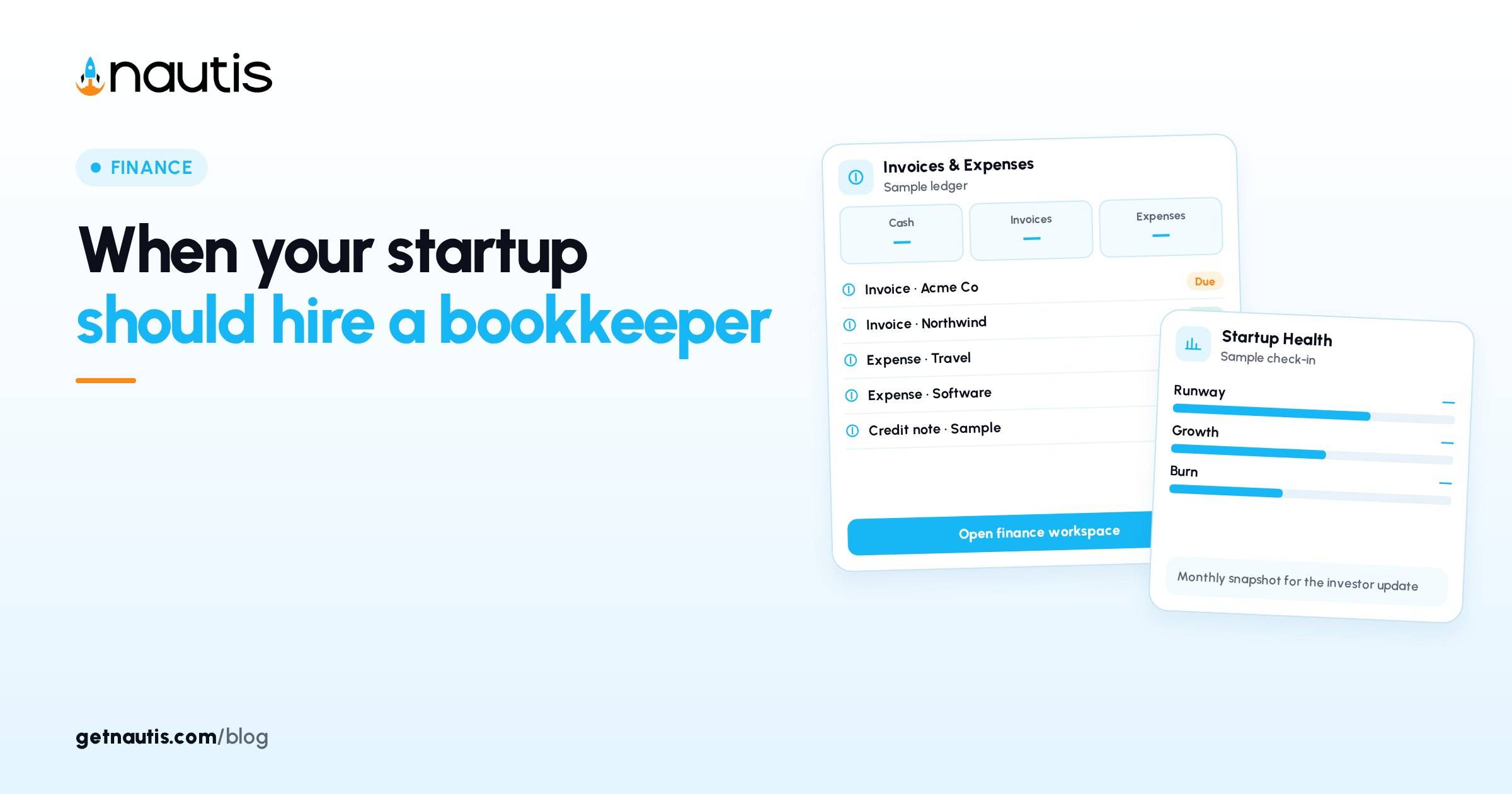
When to hire a bookkeeper is a timing decision, not a status symbol. Nautis does not provide a bookkeeper marketplace or a hire module. What it does provide are Finance tools a bookkeeper will touch every week: Expenses for logging spend and receipts, Invoices for billing customers, Startup Health for cash, MRR, and burn check-ins, and Employee Management when payroll runs in-product. You still decide when founder-led books stop being safe. This is operating guidance. It is not tax, employment, or legal advice. Use a CPA or counsel for entity, payroll tax, and contractor classification questions.
Hire for missed closes, not for a fancy title
When to hire a bookkeeper should follow observable misses. If the founder can still close the month in a few focused hours with clean bank ties, wait. If closes slip, receipts pile up, or investors get different cash stories than the bank, the hire is late already.
Illustrative Harbor Line (composite only): CEO spent two Sundays rebuilding March because Stripe payouts, card spend, and invoices never met in one place. April looked the same by the second week. That pattern is the trigger, not a LinkedIn post about building the bench.
Write the triggers before you open job boards. Otherwise every candidate interview becomes a vague chat about software brand opinions.
Company readiness table
Score your company honestly this month. Three or more yes answers usually means start the search.
Signal | Yes if | Why it matters |
|---|---|---|
Close lag | Last month is still open after business day 10 | Decisions run on stale cash |
Receipt debt | More than a week of uncoded spend or missing receipts | Expenses and taxes will lie |
Invoice drift | Sent invoices and bank deposits need a detective | Revenue and cash stories disagree |
Payroll complexity | Multiple entities, countries, or benefits you barely track | Error cost exceeds a part-time bookkeeper |
Diligence load | Investors or lenders ask for schedules you cannot produce in a day | Fundraising stalls on hygiene |
Founder hours | You spend 8+ hours a month on coding and chasing | Opportunity cost exceeds the fee |
When to hire a bookkeeper is rarely when revenue hits a round number. It is when the table says the founder is the bottleneck.
Illustrative Harbor score (composite only): close lag yes, receipt debt yes, invoice drift yes, payroll no, diligence yes, founder hours yes. Five yeses. They posted a part-time role the same week.
Illustrative deferral (composite only): a pre-revenue studio with one card and twelve transactions a month scored one yes on founder curiosity only. They deferred hiring, kept a business-day-5 self-close, and set a calendar reminder to rescore after the first five customers. When to hire a bookkeeper includes the courage to wait when the table is mostly green.
What the bookkeeper owns versus what you keep
Be explicit in the job brief.
Bookkeeper typically owns: bank and card categorization, receipt chase, accounts payable and receivable hygiene, month-end checklist, basic schedules, and clean exports for the CPA.
Founder or finance lead keeps: spending approvals, pricing, fundraising narrative, and final sign-off on Startup Health numbers you share externally.
Do not hire a bookkeeper to invent strategy. Do not keep coding transactions yourself just this quarter after they start.
Wire their week to real systems. Expenses is where you log business spend, attach receipts, sort by category, and watch spend against budgets. Invoices is where you bill customers, send PDFs, track who has paid, and record payments. Startup Health is the monthly check-in for cash, recurring revenue, and burn. Employee Management can hold compensation and payroll when you run people pay in Nautis. A hire with no system of record will recreate the spreadsheet maze you wanted to escape.
Document access: who can view payroll, who can mark invoices Paid, who can edit Expenses categories. Put that in the offer packet. Ambiguous access is how clean systems get noisy again.
Interview scorecard before the first call
Write the scorecard before interviews so every candidate is judged the same way. When to hire a bookkeeper without a scorecard produces charming conversations and weak closes.
Scorecard row | What good looks like | Disqualify if |
|---|---|---|
Month-end method | Can describe a repeatable close checklist | Only names a software brand with no sequence |
Systems comfort | Has used or can learn your stack quickly | Refuses anything outside one legacy file |
Communication | Flags issues early with examples | Waits until the CPA escalates |
Boundaries | Knows bookkeeping versus CPA advisory | Promises tax opinions they should not give |
Startup pace | Comfortable with incomplete history and cleanup | Needs a perfect chart on day one |
References | Prior founder or CPA can confirm timeliness | No one will speak to close quality |
Illustrative interview (composite only): Candidate A told a clear close story and asked how Harbor handles Stripe fees today. Candidate B promised full CFO support for a ten-hour-a-week role. Harbor hired A.
Keep the scorecard to one page. Weight timeliness and communication equal to software brand names. Ask for a sample (redacted) close checklist or a walkthrough of how they reconciled processor payouts at a prior startup. Storytelling without artifacts is a weak signal.
Part-time, firm, or full-time
Most early teams start with a part-time bookkeeper or a small firm seat, not a full-time controller.
Choose a firm when you want backup coverage and CPA adjacency. Choose an individual when you want a single accountable person and tighter product access. Move toward full-time when transaction volume, multi-entity work, or daily payables and receivables needs exceed a part-time week.
When to hire a bookkeeper at full-time usually follows sustained overload after a part-time trial, not a single busy month. Trial ninety days with written close dates. If closes still slip, the problem may be process or spending chaos, not only headcount.
Price the role against founder hours recovered, not against a big-company controller salary band. A ten-hour-a-week bookkeeper who hits business day 8 every month beats an expensive title that still leaves you rebuilding Sundays.
Illustrative ninety-day install
Illustrative Harbor Line (composite only): Week 1: access to bank, cards, Expenses, Invoices, and the receipt backlog. Week 2-4: clean categorization; document recurring vendors; set close calendar on business day 5 draft, day 8 final. Month 2: Startup Health check-ins match bank cash within a defined tolerance; Overdue invoices have an owner. Month 3: CPA package goes out without a founder weekend rebuild. Scorecard reviewed. Contract extended.
They did not ask the bookkeeper to redesign margin philosophy or rewrite sales unit math. Those stay founder and advisor topics. The hire restored a trustworthy close.
Keep the CPA in the loop when you hire. Bookkeeper and CPA roles differ; a good bookkeeper makes the CPA cheaper and calmer, not redundant. Say that split out loud in the offer so nobody expects tax strategy from a close specialist.
What not to outsource yet
Pricing experiments, investor narrative, and spend approval policy stay with operators. A bookkeeper can report that entertainment spend spiked; budgets and approval rules still need a human owner inside the company.
If you lack even a short expense policy or invoice habit, fix the minimum process in parallel with the hire. Dumping chaos on a new bookkeeper without bank feeds or receipt expectations wastes the first month.
For burn and runway labels the hire will help keep honest, see How to calculate startup burn rate and runway. For where planning tools fit beside bookkeeping, see Best startup financial planning tools for founders.
Red flags during the search
Pause a candidate if they dismiss your tools sight unseen, demand admin bank access on day one without a control discussion, or cannot name a single month-end artifact they will deliver. When to hire a bookkeeper includes protecting the company from a bad hire that creates new mess.
If co-founders disagree on timing, fill the readiness table separately, then compare. Arguments without the table recycle feelings. Tables surface which signals each person is weighting.
Contractor versus employee classification for the bookkeeper role itself needs counsel in your jurisdiction. The scorecard does not replace that review.
When to hire a bookkeeper: decide this month
Pull last quarter's close dates, hours you spent on coding, and the readiness table. If three or more signals fire, draft the scorecard and run interviews within two weeks. If zero or one signal fires, schedule a reminder for next quarter and keep your own close calendar visible.
When to hire a bookkeeper is finished as a decision when you can point to the table, the scorecard, and a start date or a dated deferral. Waiting for a round number on the revenue chart is how Sunday rebuilds become a culture.
Share the readiness table with your CPA before you post the role. They often know whether your entity and sales tax footprint already need more than a light bookkeeper. When to hire a bookkeeper after that conversation may shift toward a firm with multi-state experience instead of a solo generalist.
Put the start date or the deferral date on a shared calendar the same day you decide. A decision that only lives in chat will reopen next time someone dreads Sunday coding.
Frequently asked questions
Does Nautis hire or place bookkeepers?
No. Nautis provides Finance tools such as Expenses, Invoices, and Startup Health that a bookkeeper can use. Hiring is your decision and process.
How many readiness signals mean I should hire?
Three or more yes answers on the readiness table is a practical trigger to start interviewing.
Part-time or full-time first?
Most early teams start part-time or with a firm seat. Consider full-time after sustained overload beyond a part-time week.
What should stay with the founder?
Spend approvals, pricing, fundraising narrative, and final sign-off on external cash and runway figures.
Sources
- Nautis Expenses help. Checked on October 31, 2026.
- Nautis Invoices help. Checked on October 31, 2026.
- Nautis Startup Health help. Checked on October 31, 2026.
- How to calculate startup burn rate and runway. Checked on October 31, 2026.
Baltej Singh is a serial entrepreneur, technology leader, and Founder & CEO of Nautis and DemoVexa, with over 16 years of experience building software products, SaaS platforms, and startups. Previously the Co-Founder & CTO of SanchiConnect, he has worked extensively in the DeepTech startup ecosystem, connecting with 200+ venture capital firms and supporting a network of 4,000+ startups. Passionate about AI, automation, and entrepreneurship, he focuses on building innovative products that solve real-world problems and help businesses grow.