
How to file 1099-NEC forms for startup contractors
 Baltej Singh8 min read
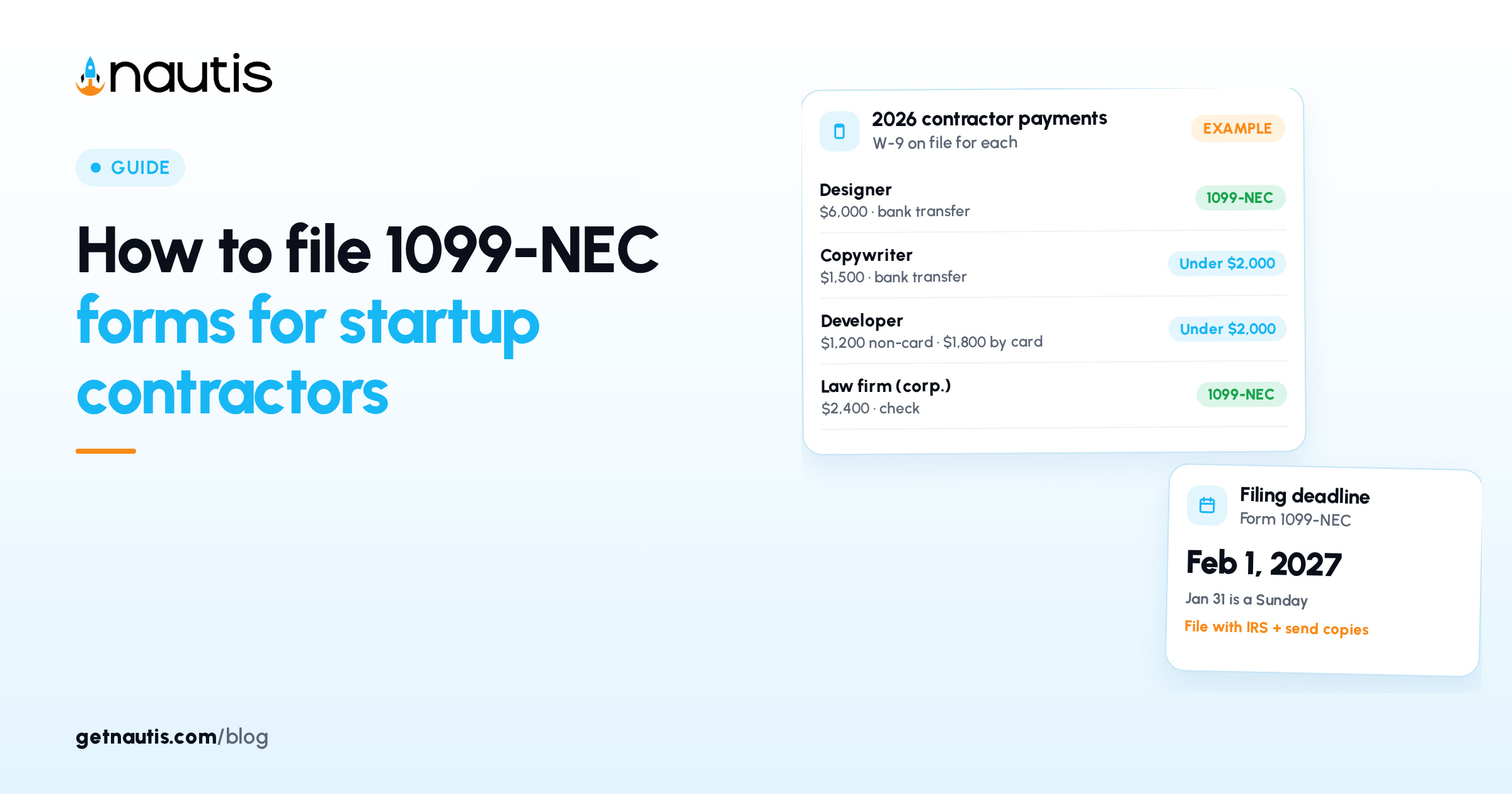
If you paid a freelancer or contractor at least $2,000 for work in 2026, you will likely need to know how to file 1099-NEC forms by early 2027. Collect a Form W-9 from each contractor before you pay them, total what you paid each one by payment method, and file Form 1099-NEC with the Internal Revenue Service (IRS) and send a copy to each contractor by the January 31 deadline. For 2026 payments, January 31, 2027 falls on a Sunday, so the IRS due date moves to Monday, February 1, 2027.
This post is general information for United States (US) startups, not legal or tax advice. Tax rules change and your situation may differ, so check the details with a certified public accountant (CPA) or tax counsel before you file.
What is Form 1099-NEC, and does a startup have to file it?
Form 1099-NEC reports nonemployee compensation: money your business paid someone who isn't your employee, for services, in the course of your trade or business. If your startup paid a contractor for services, you are probably the one who has to file it.
The IRS instructions say you generally report a payment as nonemployee compensation when all four of these are true:
- You paid someone who is not your employee.
- You paid them for services in the course of your trade or business.
- You paid an individual, partnership, estate or, in some cases, a corporation.
- Your payments to that person totaled at least $2,000 during the year.
That $2,000 figure is new. For tax years beginning after 2025, the minimum threshold for these reports rose to $2,000, and the IRS says it may be adjusted for inflation starting in 2027. Older checklists and templates may still show a lower number, so check the current instructions before you sort your list.
Personal payments don't count. Paying someone to paint your home isn't reportable, while paying a designer to build your product's onboarding screens is. If you aren't sure whether someone should be a contractor at all, settle that first. The guide to contractor vs employee status walks through what the IRS weighs.
Which contractor payments need a 1099-NEC?
Not every payment to an outside person goes on this form. How you paid and who you paid both matter.
Payment | Usually reported on | Why |
|---|---|---|
Bank transfer or check to a freelance developer, $2,000 or more in the year | Form 1099-NEC | Nonemployee compensation for services |
Same developer, paid only by credit card | Not on 1099-NEC | Card and third-party network payments are reported on Form 1099-K by the payment settlement entity |
Fees to a law firm, $2,000 or more, even if it is a corporation | Form 1099-NEC | The corporation exemption doesn't apply to legal services |
Payment to a design agency organized as a corporation | Usually not reported | Payments to corporations are generally exempt, with exceptions such as legal services |
Reimbursing an employee's travel | Not on 1099-NEC | Employee reimbursements follow Form W-2 rules |
Office rent of $2,000 or more | Form 1099-MISC, not 1099-NEC | Rent goes in box 1 of Form 1099-MISC |
The payment method row catches many founders out. If you paid a contractor partly by bank transfer and partly by card, count only the non-card payments toward the 1099-NEC total. That is why you need payment method on every contractor record, not just the amount.
How to file 1099-NEC forms, from W-9 to submission
The work is easiest if it starts the day you hire the contractor, not in late January.
Collect a Form W-9 before the first payment
Form W-9 is how a contractor gives you their correct taxpayer identification number (TIN). A TIN can be a Social Security number (SSN), an employer identification number (EIN) or an individual taxpayer identification number (ITIN). Line 3a of the W-9 asks for the contractor's federal tax classification, such as individual, C corporation, S corporation or partnership, which tells you whether they are a corporation.
Make the signed W-9 a condition of the first invoice being paid. Asking a contractor for it in January, months after the work ended, is slower and less reliable. A contractor who is a foreign person gives you Form W-8BEN instead, and reporting for foreign payees follows different rules, so bring those cases to your CPA.
Total each contractor's payments by method
After December 31, add up what you paid each contractor during the calendar year. Separate card payments from bank transfers and checks. Anyone whose non-card total is $2,000 or more gets a form, unless the W-9 shows they are a corporation and the work wasn't legal services.
Prepare and file the forms
You can file on paper or electronically. The IRS requires electronic filing once you file 10 or more information returns in total for the year, counting all types together, not just 1099-NEC forms. The IRS runs a free web portal called the Information Returns Intake System (IRIS) for this. It lets you enter forms by hand or upload a comma-separated values (CSV) file, and download payee copies to send out. You need an IRIS Transmitter Control Code (TCC) before you can use it, so apply well before January.
Send each contractor their copy
You must furnish a statement to each contractor by the same deadline you file with the IRS. You may truncate the contractor's TIN on their copy, but not on the version you file with the IRS.
Check what goes on each form
Each form needs the contractor's name, address and TIN, the calendar year, and the total nonemployee compensation in box 1a. Enter TINs in the right format: SSNs and ITINs as XXX-XX-XXXX, and EINs as XX-XXXXXXX. The IRS sends notices to payers when a contractor's TIN doesn't match its records, so compare each number against the W-9 before you submit. The IRS also runs a TIN Matching System, described in Publication 1099, that lets payers check name and number combinations in advance.
When are 1099-NEC forms due for 2026 payments?
Form 1099-NEC is due to the IRS and to each contractor on January 31. When that date falls on a weekend or legal holiday, the deadline moves to the next business day. For payments made in 2026, that makes the deadline Monday, February 1, 2027.
Here is a working calendar for an example startup that pays a handful of contractors. The dates before the deadline are suggestions, not IRS requirements.
When | What to do |
|---|---|
At hire, all year | Collect a signed W-9 before paying the first invoice |
Each month | Record every contractor payment with its date, amount and method |
November | Check that every contractor paid this year has a W-9 on file |
December | Apply for an IRIS Transmitter Control Code if you plan to e-file and don't have one |
First two weeks of January | Total payments per contractor, excluding card payments |
Mid-January | Send the list to your CPA for review |
By February 1, 2027 | File with the IRS and send each contractor their copy |
Some states also want a copy of these forms or have their own deadlines. Ask your CPA which rules apply in the states where your startup and contractors are located. For the wider set of filing dates a young company faces, the startup tax calendar basics post lays them out by quarter.
What happens if a contractor won't give you a TIN?
If a contractor won't provide a correct TIN, you may have to start backup withholding. The IRS describes this as withholding at the current rate of 24 percent from future payments, so the IRS receives the tax due on that income. Withheld amounts carry their own reporting duties, so involve your CPA before you withhold anything.
No founder wants that conversation with a freelancer they like. A simple way to avoid it:
- Put the W-9 requirement in the contract or statement of work.
- Don't pay the first invoice until the signed W-9 arrives.
- Store W-9s somewhere access is limited, because they contain sensitive numbers.
- Recheck the W-9 if a contractor tells you their business structure has changed.
How a small startup keeps 1099 records through the year
You don't need special software to stay ready. You need one place where every contractor payment lands with the same fields.
An example: a 5-person startup pays three contractors in 2026. A designer receives $6,000 by bank transfer (example figures). A copywriter receives $1,500 by bank transfer. A developer receives $3,000, of which $1,800 went by card. Under the rules above, only the designer clearly needs a 1099-NEC. The copywriter is under $2,000. The developer's non-card total is $1,200, also under the threshold. Without the payment method on each record, the founder would likely send forms to all three. If the developer had been paid entirely by bank transfer, the total of $3,000 would cross the threshold and need a form too.
In Nautis, the Expenses module can hold this record. When you add an expense manually, you fill in the Amount, Date, Category, Merchant and Payment Method, and you can attach a file in the Receipt area. A "Contractors" category, created from Categories in the Expenses sidebar, keeps those payments together, and the module produces reports you can share with your accountant. Nautis doesn't prepare or file tax forms, so the filing itself stays with you or your CPA.
To keep the January work from slipping, add a task with a due date in Task Boards for each step in the calendar above. If your books are getting harder to keep up with, read about when to hire a bookkeeper before the next filing season.
Frequently asked questions
What is the 1099-NEC threshold for 2026?
For tax years beginning after 2025, the IRS threshold for reporting nonemployee compensation on Form 1099-NEC is $2,000 per payee for the year. The IRS says the amount may be adjusted for inflation starting in 2027. Check the current Instructions for Forms 1099-MISC and 1099-NEC before you file.
When is Form 1099-NEC due for 2026 payments?
Form 1099-NEC is due to the IRS and to each contractor on January 31, moving to the next business day when that date falls on a weekend or legal holiday. January 31, 2027 is a Sunday, so the deadline for 2026 payments is Monday, February 1, 2027.
Do I send a 1099-NEC to a contractor I paid by credit card?
Generally no. The IRS instructions say payments made by credit card, payment card and certain third-party networks are reported on Form 1099-K by the payment settlement entity. Count only payments made by bank transfer, check or cash toward the 1099-NEC total.
Do I have to file 1099-NEC forms electronically?
You must e-file if you file 10 or more information returns in total for the year, counting all types together. The IRS offers a free web portal called the Information Returns Intake System (IRIS) for this, which requires a Transmitter Control Code (TCC) before first use.
Do I need a 1099-NEC for a contractor that is a corporation?
Usually not, because payments to corporations are generally exempt from 1099-NEC reporting. The main exception is legal services: fees of $2,000 or more paid to a law firm must be reported even if the firm is a corporation. The contractor's Form W-9 shows its federal tax classification.
Sources
- IRS, Instructions for Forms 1099-MISC and 1099-NEC. Checked on November 14, 2026.
- IRS, About Form 1099-NEC, Nonemployee Compensation. Checked on November 14, 2026.
- IRS, About Form W-9, Request for Taxpayer Identification Number and Certification. Checked on November 14, 2026.
- IRS, Form W-9 (PDF). Checked on November 14, 2026.
- IRS, About Form W-8 BEN. Checked on November 14, 2026.
- IRS, Backup withholding. Checked on November 14, 2026.
- IRS, E-file information returns with IRIS. Checked on November 14, 2026.
- IRS, Independent contractor (self-employed) or employee?. Checked on November 14, 2026.
- Nautis Help Center, Expenses. Checked on November 14, 2026.
- Nautis Help Center, Task Boards. Checked on November 14, 2026.
Baltej Singh is a serial entrepreneur, technology leader, and Founder & CEO of Nautis and DemoVexa, with over 16 years of experience building software products, SaaS platforms, and startups. Previously the Co-Founder & CTO of SanchiConnect, he has worked extensively in the DeepTech startup ecosystem, connecting with 200+ venture capital firms and supporting a network of 4,000+ startups. Passionate about AI, automation, and entrepreneurship, he focuses on building innovative products that solve real-world problems and help businesses grow.