How to write a statement of work for a startup
 Baltej Singh9 min read
A statement of work (SOW) is the short document that tells a contractor, freelancer, or agency exactly what to deliver, by when, and how both sides will decide the work is done. If you are searching for how to write a statement of work, start with six blocks: description of the work, where it happens, the time window, a deliverable schedule, how you will judge quality, and any special rules such as tools, travel, or security. Get those right before you argue about price.
This guide is for early startups hiring outside help on a fixed piece of work. It is not legal advice. Have counsel review any document you ask someone to sign, especially when the work touches customer data, intellectual property, or payment terms.
What a statement of work covers (and what it leaves to the contract)
A statement of work describes the work itself. A master services agreement (MSA), order form, or consulting agreement usually covers the legal relationship: payment, liability, confidentiality, intellectual property, and disputes. Many teams attach the statement of work as an exhibit so commercial terms stay stable while scope can change with a dated amendment.
Document | Main job | Typical length |
|---|---|---|
Master services agreement | Legal relationship between the parties | Long, reused across projects |
Sales proposal | Persuade the buyer to choose you | One to a few pages |
Statement of work | Define the work, dates, and acceptance | A few pages for a small project |
Change order | Amend scope, dates, or price after signing | One page with both signatures |
If you already sent a sales proposal, do not paste it into the statement of work unchanged. Keep only the scope, numbers, and dates the other side agreed to.
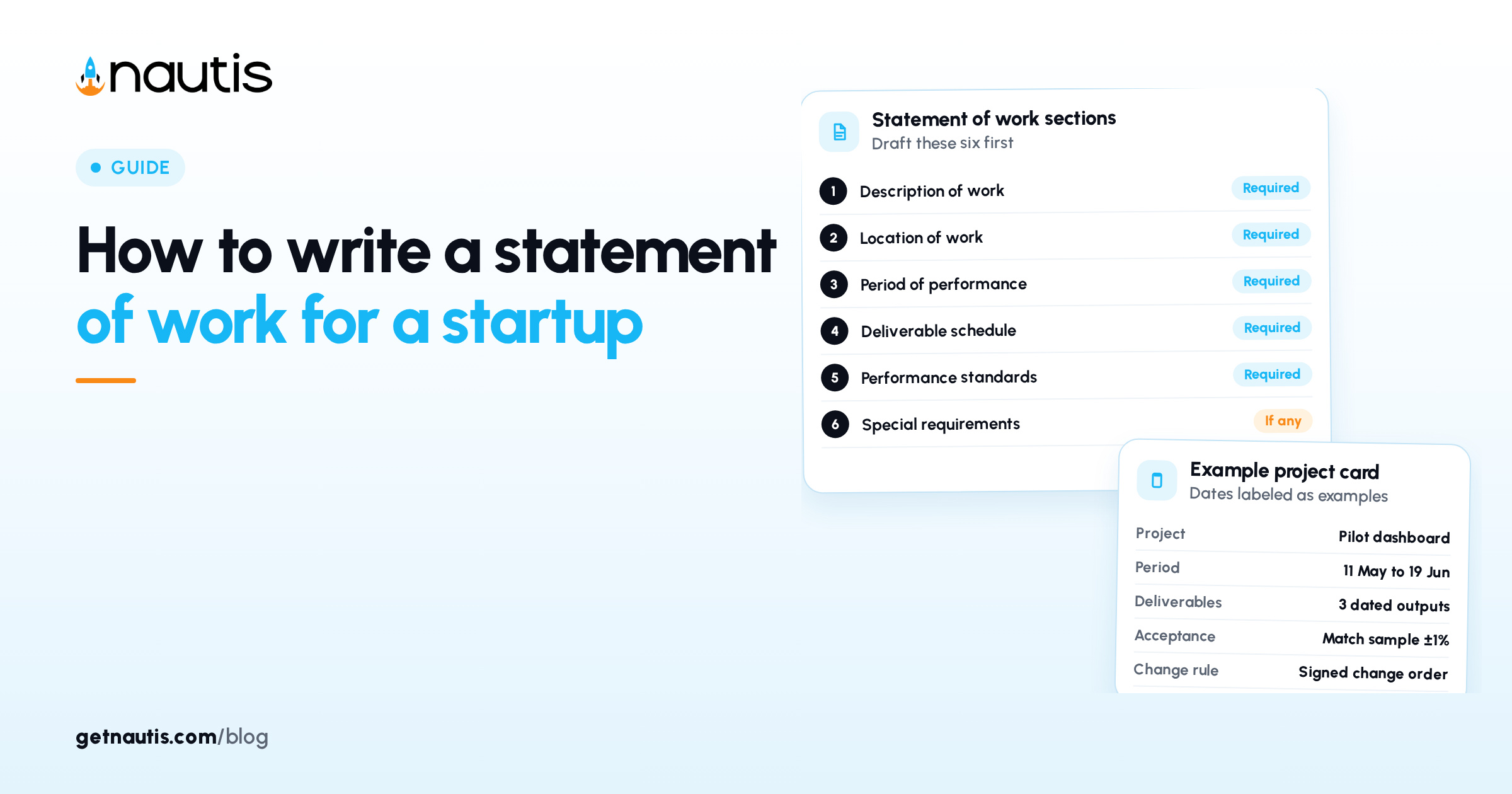
United States federal purchasing rules give a useful checklist even when you are not selling to the government. Under the Federal Acquisition Regulation (FAR) procedures for services that need a statement of work, every statement of work must include a description of the work, the location, the period of performance, a deliverable schedule, applicable performance standards, and any special requirements such as clearances or travel. Use the same six items in a startup statement of work.
When do you need a statement of work?
You need a statement of work when someone outside your payroll will produce a defined result and you want a shared definition of “done.” Typical cases:
- A designer delivering a landing page and design system files by a fixed date
- A contract engineer shipping a named feature with tests and a handoff note
- An agency running a four-week research project with a written report
- A fractional operator building a process and training one teammate to run it
You can skip a full statement of work for tiny, same-day tasks that fit in a chat message and a fixed fee under a standing agreement. Still write down the fee and the output. For anything that spans more than a week, touches production systems, or can expand without a clear edge, write the statement of work first.
Also check how you classify the person doing the work. A statement of work does not turn a contractor into an employee, and it does not replace the worker-classification rules you already use. If you are unsure whether the engagement should be a contractor relationship at all, settle worker classification before you draft.
The six sections to draft first
Write these sections before you polish sentences. Use a table so both sides can scan gaps quickly.
Section | What to write | Weak version to avoid |
|---|---|---|
Description of work | The outcome in plain language, plus the tasks that create it | “Help with product and growth as needed” |
Location of work | Remote, on-site, or hybrid, and which tools are required | No mention of access or tools |
Period of performance | Start date, end date, and any blackout weeks | “Ongoing until we feel done” |
Deliverable schedule | Each deliverable with an owner and due date | A vague “final package at the end” |
Performance standards | How you will accept or reject each deliverable | “High quality” with no check |
Special requirements | Data access, travel, security, or named people | Silence until a surprise appears mid-project |
Prefer results over hours when you can. “Deliver a tested export of invoices to CSV that matches the sample file” is clearer than “Provide 40 hours of engineering support.” Hours can live in the commercial terms if you buy time and materials; keep the result language in the statement of work either way.
How to write a statement of work section by section
1. Open with parties, title, and linked agreement
Name both parties, the project title, and the agreement this statement of work sits under. Example line: “This Statement of Work No. 1 is issued under the Master Services Agreement dated 3 March 2026 between Northline Labs Inc. and Riverbend Design LLC.” If you have no master agreement yet, say so and list which legal terms will live in a short order form instead. Do not invent legal clauses yourself.
2. Write the description of work as outcomes plus tasks
Start with one sentence for the outcome. Then list the tasks in order. Keep your own tasks in a “Customer responsibilities” list so the contractor is not blamed for access you never granted.
Example outcome sentence: “Riverbend will redesign the pricing page and deliver production-ready desktop and mobile layouts plus a short handoff note for engineering.”
3. Fix the period of performance and the deliverable schedule
Put calendar dates, not “week 3.” If a date depends on your review, write the review window (for example, “Customer reviews each draft within three business days”). Build a small schedule table:
Deliverable | Due date (example) | Acceptance check |
|---|---|---|
Kickoff notes and open questions | 6 April 2026 | Shared in the project folder the same day |
First full design draft | 20 April 2026 | Matches the written brief and brand kit |
Revised draft after one review round | 27 April 2026 | Addresses the written feedback list |
Final files and handoff note | 4 May 2026 | Files open in the named design tool; handoff lists assets and states |
Label every date in your own draft as an example until both sides confirm them.
4. Define performance standards you can actually check
Turn soft words into checks. “Professional quality” becomes “Passes the checklist in Appendix A” or “Matches the sample export on the five required columns.” If you cannot describe the check, you are not ready to hire for that deliverable.
5. List special requirements and out-of-scope work
Call out accounts the contractor needs, environments they may touch, travel, and data they must not download. Add a short out-of-scope list so the statement of work does not become an open retainer without a new price.
6. Close with change control and signatures
State that any change to scope, dates, or fees needs a written change order signed by both sides before the extra work starts. Then leave signature blocks. Send the PDF for signature with DocSign so you keep an audit trail instead of a chain of edited email attachments.
A filled-in example for a small contractor project
The figures below are examples for a fictional analytics dashboard engagement. Replace them with your own dates and fees.
Project title: Pilot dashboard for weekly revenue and churn
Contractor: Example Analytics Co.
Customer: Example SaaS Inc.
Period of performance: 11 May 2026 through 19 June 2026
Location of work: Remote, using the customer’s staging database read replica and a shared design file
Description of work: Build a read-only internal dashboard that shows weekly new revenue, churned revenue, and active accounts, with a short handoff document so an internal engineer can maintain the queries.
Deliverables (example):
- Data dictionary for the three metrics, due 18 May 2026
- Working staging dashboard, due 8 June 2026
- Production handoff note and recorded 20-minute walkthrough, due 19 June 2026
Performance standards (example): Each metric matches the customer’s finance export within one percent on a 30-day sample window. The dashboard loads in under five seconds on the staging dataset used in kickoff. The handoff note lists every query, credential owner, and refresh schedule.
Customer responsibilities (example): Provide read-only staging access within three business days of kickoff. Name one reviewer who replies to questions within two business days. Supply the finance export used for the accuracy check.
Out of scope (example): Mobile app design, billing system changes, and historical data cleanup before January 2026.
Fees: Point to the order form. Do not leave the only price inside a chat thread.
After both sides sign, create tasks for each deliverable and store the signed PDF next to the brief.
How do you handle changes after both sides sign?
Scope changes are normal. Silent scope changes are what blow up relationships. Use a one-page change order every time the work, dates, or fee moves.
Include at least:
- The statement of work number and the change order number
- What is being added, removed, or delayed
- The new due dates
- The fee impact, even when the impact is zero
- Signatures and the date both sides approved the change
Refuse to start the new work until that page is signed. If the blocker is missing access on your side, fix the access first, then decide whether dates move. Keep a running log of change orders so later readers can see how the project evolved.
When the last deliverable passes its acceptance check, mark the statement of work complete in writing. Park leftover ideas for a new statement of work instead of stretching the old one.
Keeping the statement of work next to the rest of the deal in Nautis
Draft the statement of work in Notes so the team can comment on one page. Turn each deliverable into a card on Task Boards with an owner and due date. When the PDF is ready, send it through DocSign, download the signed copy and the audit log, and file both with the project notes.
That setup does not replace a lawyer. It keeps the statement of work, the tasks, and the signatures in one place when a deliverable is late or a change order appears.
Frequently asked questions
What is the difference between a statement of work and a proposal?
A proposal persuades someone to buy. A statement of work defines the work after both sides agree to proceed. Keep persuasion language out of the statement of work and keep only scope, dates, acceptance checks, and responsibilities.
How long should a statement of work be?
Long enough to remove ambiguity, short enough that both sides will read it. For a small contractor project, a few pages with a deliverable table is usually enough. Add appendices only for checklists or samples you will actually use to accept work.
Do I need a master services agreement as well?
Often yes, if you will run more than one project with the same party or need standing terms for payment, intellectual property, and confidentiality. The statement of work then sits as an exhibit under that agreement. Ask counsel which structure fits your situation.
What belongs in a change order?
Name the original statement of work, describe what is added or removed, set the new dates, state the fee impact even when it is zero, and collect both signatures before the new work starts.
Sources
- Federal Acquisition Regulation 8.405-2, Statements of Work. Checked on November 19, 2026.
- Nautis Help Center, DocSign. Checked on November 19, 2026.
- Nautis Help Center, Notes. Checked on November 19, 2026.
- Nautis Help Center, Task Boards. Checked on November 19, 2026.
Baltej Singh is a serial entrepreneur, technology leader, and Founder & CEO of Nautis and DemoVexa, with over 16 years of experience building software products, SaaS platforms, and startups. Previously the Co-Founder & CTO of SanchiConnect, he has worked extensively in the DeepTech startup ecosystem, connecting with 200+ venture capital firms and supporting a network of 4,000+ startups. Passionate about AI, automation, and entrepreneurship, he focuses on building innovative products that solve real-world problems and help businesses grow.