How to keep a startup decision journal
 Baltej Singh8 min read
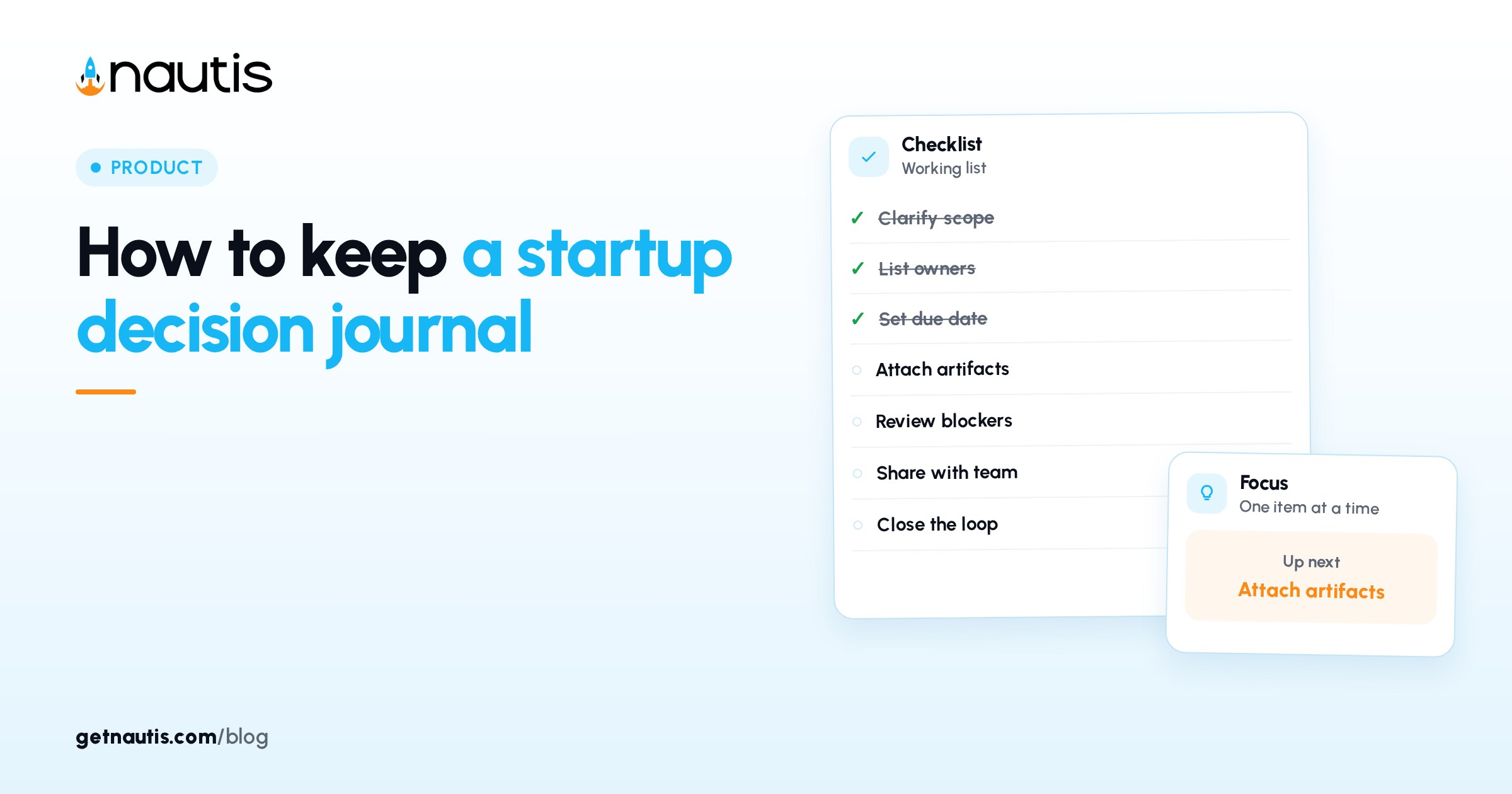
A startup decision journal is a dated record of what you chose, why you chose it, and what happened later. Memory lies after a win or a scare. The journal keeps the original confidence, assumptions, and expected outcome so you can learn on a fixed review date instead of rewriting history. In Nautis that journal lives in Decision Loop. Without a journal, teams argue from the last loud anecdote. With one, you can point at Category, Confidence level, and Expected outcome as they were on the day you chose.
What a startup decision journal is for
The journal is for calls that can change product, money, people, or strategy. Skip logging every lunch preference. Aim for enough signal that patterns appear: help text suggests at least two decisions a week so Insights has something to work with. # already expanded - skip
Founders who only log disasters create a horror library. Log calm Product and Sales calls too so Confidence vs outcome is not biased toward crisis weeks.
Illustrative scope (composite only): pricing experiments, hire or delay-hire calls, build-versus-buy, major roadmap cuts, and fundraising timing.
This is not an AI advisory board session and not a weekly team meeting. Those rooms can inform a call. The journal is where the call itself is written down and reviewed later.
Keep titles specific. "Pricing change" teaches little. "Move from unlimited trial to a 7-day trial" can be judged against an expected outcome.
Log the call while the reasons are still honest
Open Health & Wellness, then Decision Loop. Click + Add decision. The Log a decision dialog tracks required fields with a progress bar.
Required fields:
- Decision title - short and specific.
- Category - Hiring, Product, Sales, Finance, Strategy, Tech, or Marketing.
- Confidence level - Low, Medium, or High.
- Review timing - 30 days, 60 days, or 90 days from today.
When Review timing feels arbitrary, match it to when evidence will exist. A hiring call may need 90 days; a landing page copy test may need 30. Do not default every row to 90 days to avoid facing Review due.
Set Reversible? on if you can roll the call back, off if it is a one-way door. Optionally link to one active task-board milestone, click Use template to seed category prompts, and fill Short reasoning, Key assumptions, and Expected outcome. Write Expected outcome in language a skeptical cofounder would accept. Include a metric, a date window, or a customer behavior you can observe. Soft hopes belong in Short reasoning, not in the outcome line you will score later.
Illustrative weak versus strong (composite only): weak - "Sales improves"; strong - "Three qualified demos per week from the new landing page within 60 days." Expand SWOT Context if you want weaknesses and threats from your latest SWOT as a sanity check. Click Save decision.
Illustrative entry (composite only): title "Hire contractor support before full-time support lead"; Category Hiring; Confidence Medium; Review timing 60 days; Reversible on; Expected outcome "First-response time under four hours for two months."
If Burnout Radar is high or the decision is irreversible, take the 24- to 48-hour pause warning seriously. Logging still works; the warning is a nudge to slow down, not a lock. You can still Save decision after you pause. The point is to avoid one-way doors made at midnight after a brutal support week.
Run a status cycle you can see on Timeline
After Save decision, the row lands on the Timeline tab as Pending review with a review date. Status moves as time passes and as you work the queue.
Status | What it means | What you do |
|---|---|---|
Pending review | Logged; review date still ahead | Leave it alone unless you must Edit before review |
Review due | Review date arrived or passed | Click Review; pick an Outcome; write Reflection |
Reviewed | Outcome saved | Leave locked; read it in Insights later |
Badges can mark High-risk week (burnout score was high when you logged), Irreversible, and a milestone tag when linked. Click View to read reasoning, assumptions, expected outcome, and any review. Use View when a teammate asks why a path was taken. Sharing the record beats reconstructing a Slack thread that lost half its context.
Illustrative weekly pass (composite only): Monday open Timeline, clear every Review due row, skim Pending review dates for the next two weeks.
Do not Edit after a review. Reviewed decisions lock so hindsight cannot rewrite the past. If you logged a mistake, delete and re-log only when you must; prefer honesty over tidy fiction. Before review, Edit is available on unreviewed rows if you mistyped Category or Review timing. Fix facts early. Do not "fix" reasoning soft so the future review feels kinder.
Review on 30, 60, or 90 days with the same honesty
When the status strip says decisions need review, open Timeline and find Review due rows. Click Review. Choose Outcome: Better than expected, As expected, or Worse than expected. Add a short Reflection on what surprised you and what you would change. Optionally use Generate reflection prompts for questions, then Save review.
Illustrative reflection (composite only): "Worse than expected - we assumed inbound volume stayed flat; it doubled. Next hiring call will include a volume trigger in Key assumptions."
Concrete Expected outcome lines make this step fast. "Feel better about support" cannot be scored. "First-response time under four hours" can.
Skipped reviews stay Review due and starve Insights. The dashboard keeps reminding you; the cost is fewer patterns, not a software failure. Batch reviews on a fixed weekday. Five Review due rows on Monday morning is easier than hunting them when a board meeting needs a story. Protect a recurring thirty-minute review block on the calendar the same way you protect payroll. A startup decision journal that only grows Pending review rows is a museum, not a learning system.
Read Insights before you trust your gut again
Open the Insights tab for charts on Confidence vs outcome, outcomes by Category, outcomes by Burnout risk level the week you decided, and review on-time habits. AI insights describe patterns in plain language. Summary cards surface high-confidence calls that underperformed. Reports holds downloadable summaries for quarterly rereads. Bring a Reports export to quarterly planning so the conversation starts from outcomes, not from whoever speaks first. Pair that with a quick Timeline skim of Irreversible badges from the past quarter.
Illustrative insight use (composite only): three High confidence Marketing calls landed Worse than expected while Medium confidence Product calls tracked As expected; next Marketing bets start at Medium until a pause habit sticks.
Anyone with Decision Loop read permission can see the log. Adjust Members & Roles if the journal should stay founder-only. Teach the same logging bar to any cofounder who can bind the company. Split journals by secrecy needs only through permissions, not through parallel spreadsheets that never get reviewed.
AI-powered templates, reflection prompts, and weekly insights use a small amount of organization AI credits. Logging and reviewing decisions does not.
Separate reversible doors from one-way doors in the log
The Reversible? toggle is not decoration. Toggle on when you can undo cheaply. Toggle off for one-way doors such as public pricing promises, signed exclusivity, or a fired customer segment you cannot quietly restore.
Illustrative split (composite only): reversible - try a new onboarding email sequence for two weeks; irreversible - announce a price increase to all customers.
Irreversible rows can show an Irreversible badge on Timeline. Pair those with a pause when burnout risk is high. Do not treat the toggle as a personality test; treat it as a blast-radius label for your future review.
Save long debates for irreversible bets. Ship reversible calls faster, then let the review date teach you whether the Expected outcome landed.
Keep the journal light enough that you still open it
Two solid entries beat ten vague ones. Use Use template when the reasoning box is blank. Link at most one milestone; mention other threads in Key assumptions.
Illustrative cadence (composite only): log on the day you decide; block twenty minutes every Monday for Review due rows; open Insights on the first Monday of the month.
When a decision needs stress-testing before you choose, do that work first, then log the final call here. The journal's job is memory and review, not live debate. If advisors disagreed, put the disagreement in Short reasoning or Key assumptions. Future-you needs the conflict, not a polished myth that everyone aligned.
Delete rows logged by mistake from the row menu. Do not delete Reviewed rows to hide a miss; that erases the lesson Insights needs. New Admins should read ten Reviewed rows before they change how the company decides. Culture ships through those examples faster than through a values slide.
A startup decision journal pays off when Friday-you can still read Monday-you without embarrassment filters. Log the call, review on the date you promised, and let Confidence vs outcome numbers argue with your mythology.
Start with one honest entry today, set Review timing you will honor, and clear Review due before you add another strategy offsite to the calendar.
Keep the journal in the same place every time. Parallel docs outside Decision Loop become the place lessons go to die.
Frequently asked questions
What belongs in a startup decision journal?
Calls that change product, money, people, or strategy. Log at least a couple each week with specific titles and measurable expected outcomes so reviews are scorable.
Where do I log and review decisions in Nautis?
Open Decision Loop under Health & Wellness. Use + Add decision to log, Timeline to find Review due rows, and Review to save Better than expected, As expected, or Worse than expected with a Reflection.
Can I edit a decision after I review it?
No. Reviewed decisions lock so hindsight cannot rewrite history. Edit only before review, or delete a mistaken unreviewed row and re-log if you must.
Do teammates see my decision journal?
Anyone with Decision Loop read permission in the organization can view the log. Tighten Members & Roles if it should stay founder-only.
Sources
- Nautis Decision Loop help. Checked on October 31, 2026.
- Nautis Task boards help. Checked on October 31, 2026.
- Nautis SWOT analysis help. Checked on October 31, 2026.
- Nautis Burnout Radar help. Checked on October 31, 2026.
Baltej Singh is a serial entrepreneur, technology leader, and Founder & CEO of Nautis and DemoVexa, with over 16 years of experience building software products, SaaS platforms, and startups. Previously the Co-Founder & CTO of SanchiConnect, he has worked extensively in the DeepTech startup ecosystem, connecting with 200+ venture capital firms and supporting a network of 4,000+ startups. Passionate about AI, automation, and entrepreneurship, he focuses on building innovative products that solve real-world problems and help businesses grow.