How to pay yourself as a startup founder
 Baltej Singh8 min read
Paying yourself as a founder is a cash-policy problem before it is a lifestyle problem. Underpaying until you snap, or overpaying until runway collapses, both come from the same gap: no written rule that ties salary to bank balance and review dates. This post is a one-page operating policy for early teams, plus how to record compensation in Nautis. It is not legal, tax, or employment advice. Entity type, payroll taxes, and benefits rules vary; ask a CPA and counsel before you change how money leaves the company.
Paying yourself as a founder without a mood-based number
Guessing a salary in the shower produces fights later. Write the number, the floor you will not go below without a board or co-founder vote, the cash trigger that forces a cut discussion, and the next review date. Keep that page short enough that two founders can recite it. Paying yourself as a founder stays sustainable when the policy outlives a good fundraising week and a bad sales week. If you cannot explain the raise rule in one breath, the page is already too clever.
Co-founders should take the same written process even when amounts differ for role or location. Secret side draws destroy trust faster than a lower equal salary. If amounts differ, write why in one sentence on the policy page. Investors who diligence payroll will ask anyway; a clean Compensation revision history is cheaper than a story.
Seven clauses that belong on the one-pager
- Purpose: living floor so the company does not depend on unpaid panic.
- Amount: monthly net or Annual CTC equivalent you will actually run through payroll.
- Start date: when the amount begins; no silent back-pay without a recorded revision.
- Floor: the minimum you protect unless cash gates force a temporary cut.
- Raise rule: what must be true before compensation rises (for example runway above N months after the raise).
- Cut rule: what forces an automatic discussion (for example cash below X or runway below Y).
- Review date: calendar date, owner of the review, and where the decision is logged.
Write raise and cut rules in the same units you use in Startup Health so you are not converting folklore mid-meeting.
Print it. Date it. Put the owner of the review on the page. Stop expanding the document into a novel. Paying yourself as a founder does not require a compensation committee at seed; it requires a page you reopen when emotions run hot. Store a PDF copy in Documents or a company Note so the policy survives laptop swaps.
Runway gates (decision table, not a salary menu)
Use gates so raises and cuts are mechanical discussions. The numbers below are illustrative thresholds for a fictional company, not advice for yours. Set your own X and Y with your CPA and co-founders. Recalculate gates after every material cash event: close, big customer prepay, or unexpected tax bill. Put the new gate numbers on the policy page the same day.
Gate (illustrative) | What you do | What you do not do |
|---|---|---|
Runway above your raise line after modeling the new pay | Discuss a scheduled raise on the review date | Raise mid-month because a single customer closed |
Runway between raise line and cut line | Hold pay flat; improve cash or revenue | Quietly add allowances that hide a raise |
Runway below your cut line | Open the cut discussion within seven days | Keep full pay and hope the next wire arrives |
Cash below your absolute floor | Pause non-essential spend; revisit founder pay same week | Put personal expenses on the company card instead |
Fundraise closes and bank balance jumps | Re-run gates with post-close cash; then review | Instant lifestyle leap before the policy page updates |
Model the raise or cut in Financial Planner or at least against the burn math in How to calculate startup burn rate and runway before you celebrate. Paying yourself as a founder is a scenario input, not a vibe. If the Planner dashboard shows burn and runway breaking after the raise, the gate table already answered no. Change revenue or spend plans first, not the policy after the fact.
Record the decision where payroll actually runs
In Employee Management (checked 31 Oct 2026), founders with HR Management permissions can Add employee, store bank details, set compensation, Run payroll, and Create payout. Read-only members can browse but cannot pay. From Human Resources, open Employee Management. Open your employee profile, Compensation section, Add revision (Revision type new for the first entry, then revision or promotion later). Enter Annual CTC, adjust Basic % and HRA % if your plan uses those splits, add Allowances and Deductions, Save. The revision is dated so history stays clean.
Then Run payroll for the pay frequency (Monthly by default), Continue to draft, and use Payouts with Create payout for Month, Year, Country, Currency, and Pay frequency. Net pay follows the latest compensation revision. Do not "pay yourself" only via unmarked bank transfers that never hit Compensation history. Audits and co-founders both hate mystery withdrawals. Employment type on Add employee (Full time, Part-time, Contractor, Intern) should match how counsel and your CPA classify you. Mislabeling yourself as a contractor in the directory while running payroll as something else creates cleanup work nobody wants during a raise.
Cash pulse beside payroll
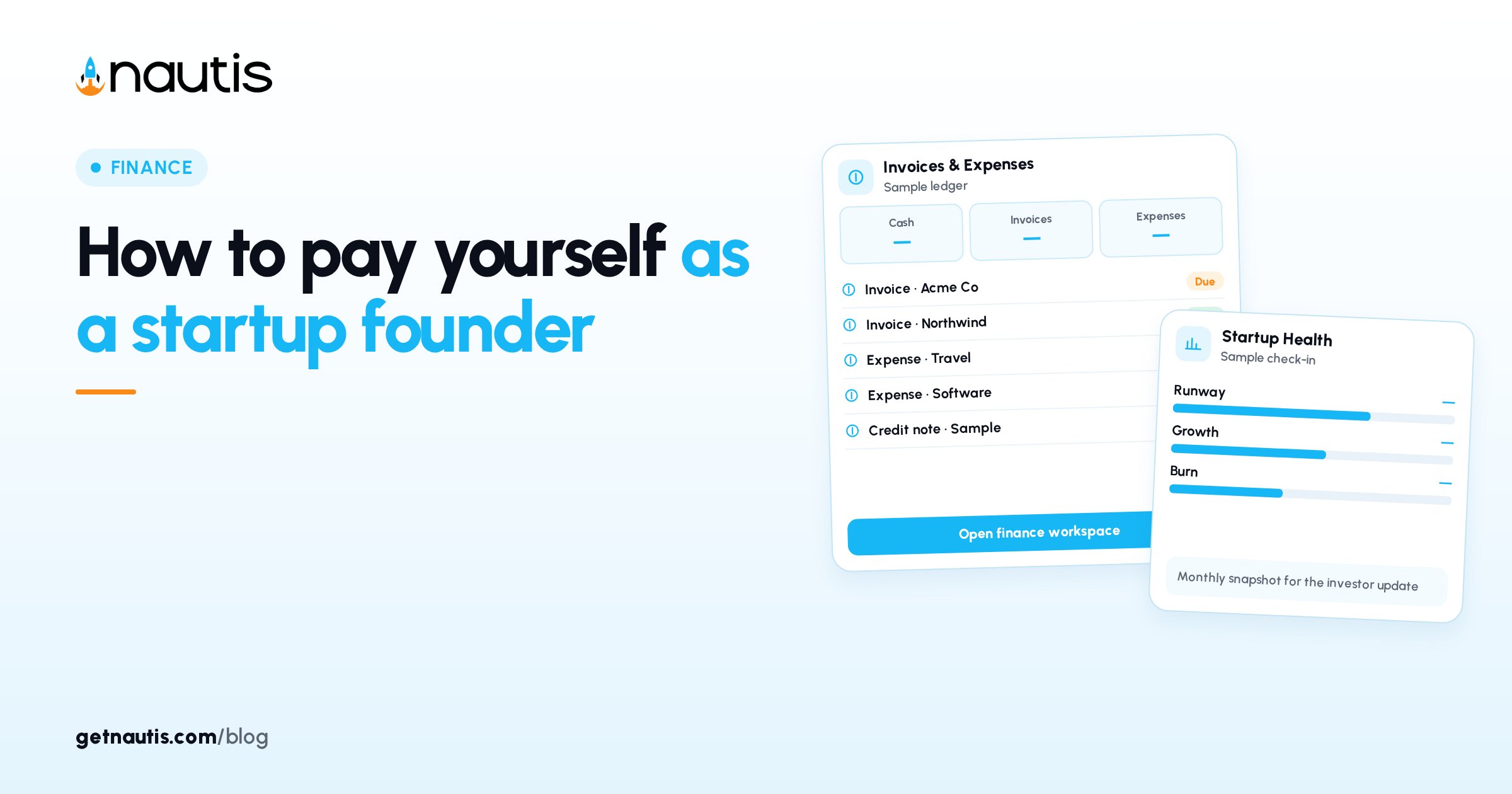
Log the company pulse in Startup Health with the monthly check-in for cash, recurring revenue, and burn so runway charts stay current. If Startup Health says runway is short while your salary still assumes abundance, believe the check-in and open the gate table. Expenses still need clean categories for non-salary spend; founder pay belongs in payroll records, not as a vague card expense. When you Create payout, confirm Currency and Pay frequency match the policy page so the one-pager and the Payouts tab do not disagree.
Illustrative co-founder reset (composite only)
The story below is a composite illustrative example, not a real company.
Illustrative setup: Two co-founders took irregular draws for a year. One month felt rich after a pilot invoice; the next month rent was late. They wrote a one-pager: equal monthly pay, floor defined, raise only if runway stayed above ten months after the raise, cut discussion if runway fell under six. They Add revision in Employee Management the same day, ran the next payroll cycle through Payouts, and put a quarterly review on the calendar.
Illustrative result: A later enterprise deposit did not trigger an instant raise. They re-ran the gate table, updated Startup Health, and waited for the review date. Paying yourself as a founder became boring, which was the point. A second illustrative check: they refused a new Allowance that would have mimicked a raise between reviews; any change had to be a dated Compensation revision. They also stopped paying personal software on the company card to "make up" for a lower salary.
What to take to counsel and your CPA
Multi-founder fairness
Equal process does not always mean equal pay. Role, location, and time commitment can justify different Annual CTC numbers if the policy page states the reason and both parties Save matching revision dates. What you cannot do is run informal draws for one founder while the other lives only on the recorded payroll. Fairness is visibility plus rules, not identical cents.
Entity choice (LLC, C corp, and others), whether you should be on W-2 payroll, how to handle distributions versus salary, multi-state rules, and equity tax all sit outside this blog. Bring them your one-pager, your Cap Table reality, your latest Startup Health check-in, and your bank history. Ask what must change in Compensation revisions and payroll frequency. Do not copy a Twitter salary number into Annual CTC without that conversation.
International founders should treat labels like HRA % as plan-specific payroll fields in Nautis, not as a claim that every jurisdiction uses them. Configure Settings with someone who knows local payroll.
Review ritual that prevents silent drift
On the review date, open the one-pager, Startup Health latest check-in, and the latest Compensation revision side by side. Ask only three questions: Did we hit a gate. Does the amount still meet the living floor without breaking the cut line. What exact revision will we Save if anything changes. Log the answer in a dated Note. If nothing changes, write "hold" and the next review date anyway. Invite the same people every time; surprise attendees turn the ritual into a negotiation ambush.
Refuse mid-cycle lifestyle creep: new Allowances that recreate a raise, personal spend on company cards, or skipping Run payroll because a manual transfer felt faster. If you must change pay between formal reviews because a gate tripped, still Add revision with the real date and reason so history stays honest. Paying yourself as a founder compounds through dated revisions and boring payouts. Write the page, set the gates, record Compensation, run payroll, review on the calendar, and let counsel handle the edge cases the spreadsheet cannot.
Frequently asked questions
How should startup founders decide their salary?
Write a short policy with amount, living floor, raise and cut rules tied to cash or runway, and a review date. Agree it with co-founders before emotions or a single good month set the number.
How do I record founder pay in Nautis?
In Employee Management, open your profile Compensation section, Add revision with Annual CTC and any allowances or deductions, Save, then Run payroll and Create payout on the Payouts tab so history stays dated.
When should founders cut or raise their own pay?
Follow written gates. Illustrative pattern: discuss raises only above a modeled runway line on review dates; open a cut discussion when runway or cash falls below your cut line. Set real thresholds with your CPA.
Is this tax advice?
No. Entity type, W-2 versus distributions, and multi-state rules need a CPA and counsel. This post is an operating policy and payroll-recording habit only.
Sources
- Nautis Employee Management. Checked on October 31, 2026.
- Nautis Startup Health. Checked on October 31, 2026.
- Nautis Financial Planner. Checked on October 31, 2026.
Baltej Singh is a serial entrepreneur, technology leader, and Founder & CEO of Nautis and DemoVexa, with over 16 years of experience building software products, SaaS platforms, and startups. Previously the Co-Founder & CTO of SanchiConnect, he has worked extensively in the DeepTech startup ecosystem, connecting with 200+ venture capital firms and supporting a network of 4,000+ startups. Passionate about AI, automation, and entrepreneurship, he focuses on building innovative products that solve real-world problems and help businesses grow.