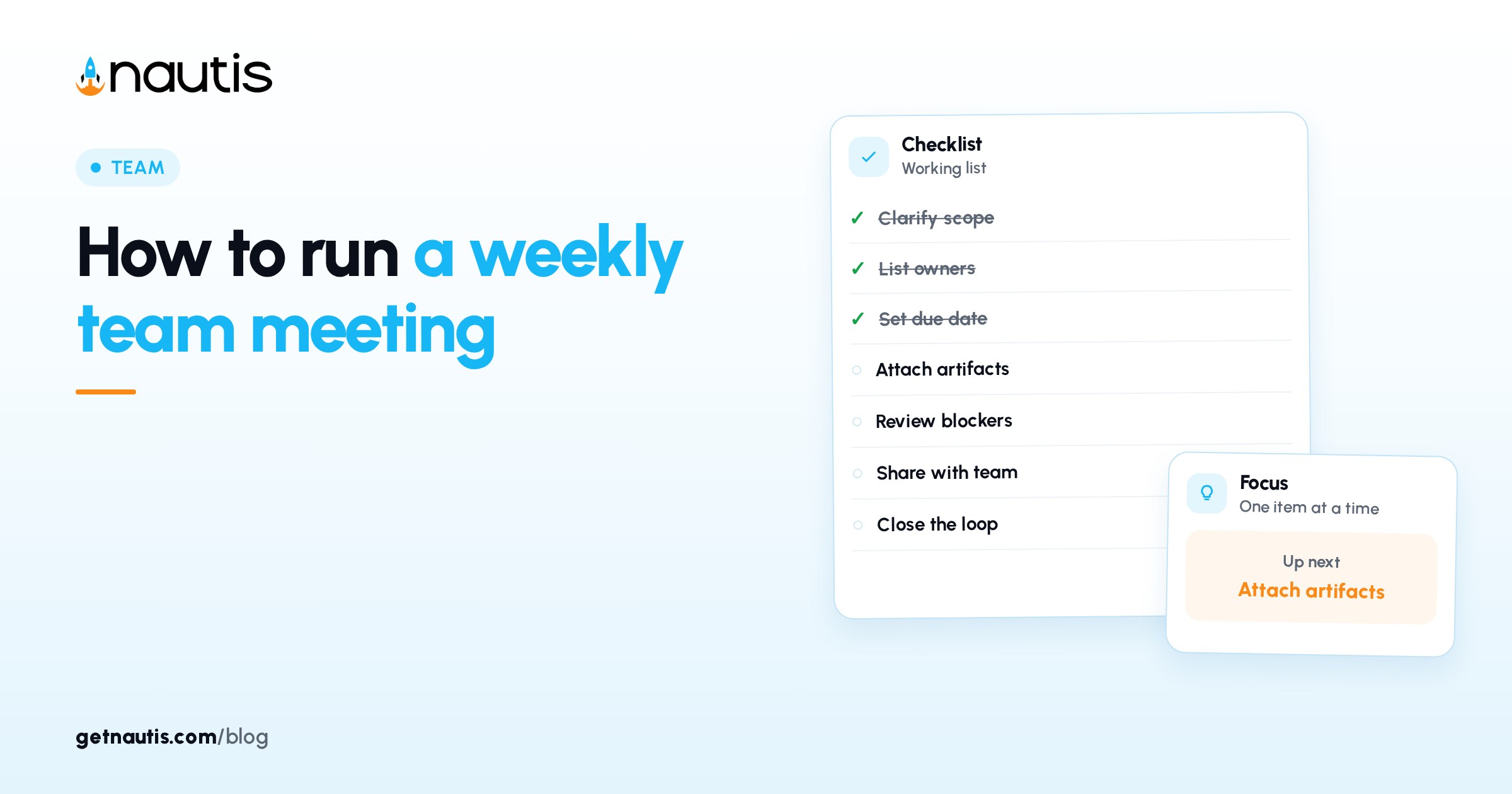
How to run a weekly team meeting
 Baltej Singh8 min read
How to run a weekly team meeting starts with a promise: the room will leave with decisions, owners, and a hard stop. Without that promise, the hour becomes status theater and people protect their calendars by tuning out. Early teams still need one shared weekly room. Keep it short, repeatable, and boring in the best way.
How to run a weekly team meeting people will keep attending
Attendance follows usefulness. If the meeting only restates chat, strong people will skip. If it clears blockers, assigns owners, and ends when the exit list is complete, they will protect the slot.
Illustrative standard (composite only): "Thirty to forty-five minutes, same day each week, camera on for remote folks, phones down, and no open laptops except the note-taker." If remote and in-person people share the room, give remote voices first call on blockers. Otherwise office side-chat becomes the real meeting and the exit list lies.
YC's essential startup advice library stresses focus and speed over process for its own sake. Use that spirit: fewer meetings, clearer ones. This post is the weekly team meeting pattern, not a daily standup and not an investor prep session.
Name a facilitator and a note-taker before the invite goes out. Solo facilitation plus note-taking is how action items vanish. Rotate note-taking monthly if the same person always loses their voice in the discussion. The facilitator stays stable longer so the exit ritual does not reset every week.
Decide what belongs in the room
A weekly team meeting is for cross-team decisions, shared risks, and commitments that need witnesses. It is not for deep design debates, performance reviews, or fundraising theater.
Write a one-line purpose on the invite Description. Illustrative purpose (composite only): "Align on weekly outcomes, unblock cross-team work, and leave with named owners."
Park topics that need a smaller room. Say the parking lot out loud when someone starts a two-person rabbit hole. Schedule that follow-up with New Meeting after you adjourn instead of hijacking the weekly slot. Publish who must attend versus who is optional. Optional people should feel safe to decline when the agenda has nothing for them. Forced full-company attendance for every tactical week trains people to multitask.
If only one person needs an update, use async notes. Reserve the live room for moments when silence would create conflicting work.
Founders sometimes use the weekly meeting as a personal briefing dump. Save personal triage for a private pass and bring only the company-level asks. The room is not your inbox aloud.
Build an agenda with exit criteria, not vibes
Publish the agenda the day before. Keep sections stable so people prep without guessing the format.
Exit row | Filled when | Owner in the room |
|---|---|---|
Last week commitments | Each prior owner says done, slipped, or blocked | Facilitator marks the sheet |
This week outcomes | Team agrees on at most five company-level outcomes | Founder or lead confirms |
Blockers | Each blocker has a next step and a person | Note-taker captures names |
Decisions | Question, choice, and decide-by or decided-now | Facilitator repeats the decision aloud |
Risks | Any red risk has a watch owner until next week | Named person accepts |
Parking lot | Offline topics listed with who will meet | Facilitator ends debate |
Illustrative rule (composite only): the meeting may end early when every exit row is filled; it may not end while blockers lack owners.
Avoid stuffing metrics theater into every section. Bring numbers only when they change a decision. A metrics dump without a question is a slide, not a meeting. Pre-reads beat live discovery. If a doc needs more than three minutes of silent reading, send it the day before and start the section with questions, not a page-turn.
Prep the day before so the room starts warm
Send the agenda and any pre-reads at least one working day ahead. Include last week's exit table with status so owners arrive knowing what they owe.
Illustrative pre-note (composite only): "Agenda attached. Please update your commitment rows before 10:00. Bring blocker asks as one sentence each."
People who skip prep lose the right to reopen settled sections without a new fact. The facilitator can defer unprepared deep dives to a smaller follow-up instead of punishing the whole room.
If time zones make a single live hour painful, keep the weekly slot for the overlapping core and require async updates from others in the exit sheet before the call. Do not run two full weekly meetings that drift apart.
Keep the pre-note shorter than a page. Long briefs become unread briefs. Link out to Task boards or docs instead of pasting novels into the calendar Description.
Put the meeting on the calendar the same way every week
In Nautis, open Meetings under Profile & Company. For a standing internal meeting, use New Meeting rather than a public booking link.
Fill Title (for example, "Weekly team meeting"), optional Description with the purpose line, Date, Start time, Duration, and Timezone. Set Location to your video provider, In Person, or Custom Link. Add Attendees from Team Members or by name and email so each person gets an invite with a calendar attachment. Set Recurrence to weekly and choose an end date only if the ritual is truly temporary.
Illustrative setup (composite only): Title "Weekly team meeting", Duration 45 minutes, Recurrence weekly, Attendees the whole product and go-to-market group.
Click Create. Open the meeting later from the calendar or list to edit or cancel. Write the facilitator name in the recurring Title or Description so substitutes know who runs the exit list when the usual lead is out. Cancelling notifies invitees; add a reason when you can.
Keep Availability Schedules and Event Types for external booking pages and intro calls. Do not force the weekly team meeting through a public booking link meant for outsiders. Share & Links and booking page URLs are for candidates, customers, and other external bookers. Your weekly team already has seats on the recurring invite.
If Google Calendar or Outlook is connected under Integrations, external events help you avoid double-booking. Toggle Show external calendar events when you need to see the conflict.
Capture owners before anyone leaves
Decisions without owners are rumors. Before adjournment, the note-taker reads every new commitment with a name and a due date.
When a transcription tool such as Fathom, Fireflies, or Read.ai is connected, open the meeting details and scroll to Meeting transcript. Copy can grab formatted notes. Under Action items, use Add to Task Board so each item lands on a Task Board with priority, due date, and assignees; the item then shows On Task Board. That path is for capture after the room agrees, not for inventing work the team never accepted.
Illustrative close (composite only): four action items added to the company board with owners present; one decision logged in Decision Loop with the choice restated aloud.
For deeper conversion of notes into tasks after messy calls, keep that workflow separate. The weekly meeting succeeds when ownership is spoken in the room first. Reject "someone should" language. If no name volunteers, the facilitator assigns or the item returns to the parking lot. Unowned work is how the same blocker returns next week with new guilt.
Attendees who are not yet Contacts can be saved with Add to contacts from the meeting details when you meet outsiders. For an internal weekly, Team Members on the invite are usually enough.
End on the exit list, then protect the calendar
When the exit rows are complete, the facilitator ends the meeting even if minutes remain. Empty air invites new topics that steal the next deep-work block.
If the exit list is unfinished at the hard stop, schedule a focused follow-up with New Meeting for the people who must decide. Do not silently extend every week or the Duration you published becomes fiction.
Illustrative ending script (composite only): "Exit list is green except one blocker. Priya owns that by Wednesday. We are done."
Afterward, send a short written recap the same day: decisions, owners, dates. Email from the transcript tools can go to attendees if you use that path; otherwise paste the exit table into Team chat or Notes. Same-day beats a perfect doc on Friday.
Once a month, spend five minutes of the meeting reviewing the meeting itself. Cut a section nobody uses. Shrink Duration if you finish early three weeks running. When Duration must change, edit the recurring series once and say why in the next pre-note. Silent length creep is how trust dies. Cancel the series if the company can run on async updates plus smaller rooms. Ask three audit questions: What decision happened only because we met? What could have been async? What repeatedly spills past the hard stop? Change one thing the following week, not five.
How to run a weekly team meeting well is mostly restraint: a fixed purpose, an exit table, a recurring invite people trust, and owners named while everyone is still present.
Protect the hour after the meeting as focus time on the same calendars when you can. A weekly meeting that always spills into the next block teaches the company that hard stops are optional.
Frequently asked questions
How long should a weekly team meeting be?
Long enough to finish the exit list and short enough to protect maker time. Many early teams fit it in 30 to 45 minutes. Shrink Duration if you finish early three weeks in a row.
Should we use a public booking link for the weekly team meeting?
No. Use New Meeting with weekly Recurrence and Team Members as Attendees. Keep Event Types and Share & Links for external bookers.
How do action items get onto a board?
Agree owners in the room first. If a transcript is connected, open Action items and click Add to Task Board to set board, priority, due date, and assignees.
What if we run out of time before the exit list is done?
Stop on time. Schedule a focused New Meeting for the people who must decide. Do not silently extend every week.
Sources
- Nautis Meetings help. Checked on October 31, 2026.
- Nautis Task boards help. Checked on October 31, 2026.
- Nautis Decision Loop help. Checked on October 31, 2026.
- YC's essential startup advice. Checked on October 31, 2026.
Baltej Singh is a serial entrepreneur, technology leader, and Founder & CEO of Nautis and DemoVexa, with over 16 years of experience building software products, SaaS platforms, and startups. Previously the Co-Founder & CTO of SanchiConnect, he has worked extensively in the DeepTech startup ecosystem, connecting with 200+ venture capital firms and supporting a network of 4,000+ startups. Passionate about AI, automation, and entrepreneurship, he focuses on building innovative products that solve real-world problems and help businesses grow.