How context switching drains a founder's day
 Baltej Singh8 min read
The cost of context switching shows up when chat, email, and tabs interrupt a half-finished task. The bill arrives as late decisions, shallow reviews, and evenings spent rebuilding context you already had at noon. Count the switches for one day, then group similar work and keep one workspace in front of you. You do not need a perfect schedule. You need fewer forced restarts.
The cost of context switching in a one-day log
Spend one ordinary day logging every time you leave a task for something else. Use four columns only.
Time | Left | For | Restart minutes |
|---|---|---|---|
10:12 | Spec draft | Slack ping | 8 |
10:40 | Spec draft | Investor email | 12 |
11:15 | Spec draft | Quick "yes" on a vendor ask | 6 |
Restart minutes are your honest guess of how long it took to remember where you were. When you close the log, sum the restarts. That sum is the visible part of the drain founders usually ignore.
APA's public page on multitasking reports that switch costs "may be relatively small, sometimes just a few tenths of a second per switch," and that they "can add up to large amounts when people switch repeatedly." It also states, quoting Meyer, that "even brief mental blocks created by shifting between tasks can cost as much as 40 percent of someone's productive time" (APA: Multitasking: Switching costs). As of November 2026 those lines are still on that page. Treat them as a research warning, not a personal stopwatch. Your log is the number that matters for your week.
Rules for the log:
- Count self-interrupts (you opened another app) the same as external pings.
- Skip meals and short walks. Count tool hops that change the mental job.
- If you bounce three apps to answer one question, that is three switches.
- Tag each row as decision, reply, or nothing. Nothing is the expensive kind.
- Note whether the left task was complex (writing, architecture, pricing) or simple (filing a receipt). Complex left-tasks usually cost more restart minutes.
After five workdays, chart daily restart totals. Look for a pattern by hour, not only by day. Many founders discover the expensive cluster sits in the first ninety minutes after inbox open.
Group similar work instead of reacting to every ping
Finish one kind of work before you open the next. A practical early-stage split in plain words:
Kind of work | Examples | Tools open |
|---|---|---|
Making | Specs, code, deck narrative | Editor only |
Deciding | Approvals, pricing choices, hire yes/no | Docs + calendar |
Talking with people | Email, investor replies, customer threads | Inbox + CRM |
Admin chores | Expenses, renewals, forms | Finance + browser |
Put making work where your energy is highest. Park talking-with-people behind a fixed start time so the inbox cannot rent the morning by default. Move a leftover decision into the next deciding window instead of sprinkling yes/no through making time.
Label calendar holds with the kind of work so you can see, at a glance, whether the week is heavy on making or heavy on talking. If three days show zero making time, the calendar is the problem, not your discipline.
YC's essential startup advice keeps pushing founders toward talking with users and shipping progress. Grouping work protects the hours where that shipping actually happens. Customer interviews still belong on the calendar; schedule them on purpose inside a deciding or talking window.
A simple sequencing rule: never put admin chores between two making blocks. Admin work is sticky. It leaves browser residue that invites more admin.
Cap open loops before you start making work
An open loop is a half-finished thought that will yank you back mid-sentence. Before a making block, close or park loops in writing.
Loop | Park action |
|---|---|
Short question you can finish in one line | Finish it, then return |
Question that needs judgment | Write "decide at 14:00" and stop |
Mail that is not today | Star it and leave it closed |
Errand that popped into your head | One scratch line, then ignore |
Half-written comment on a doc | Finish the sentence or add "resume here" |
Use Notes for the scratch list so parking does not mean another browser tab. Keep mail closed while you make. Open Email inbox only inside a talking window.
The goal is not inbox zero. The goal is zero unfinished sentences competing with the making task. Founders often lose ten restart minutes to a comment they meant to "quickly" finish.
Keep one workspace for the work in front of you
Switching tools is still switching tasks. For each kind of work, open the minimum set and close the rest.
Kind of work | Keep | Close or quit |
|---|---|---|
Making | Editor, one reference doc | Chat, mail, social |
Deciding | Agenda note, decision materials | Build tools |
Talking with people | Inbox, CRM or lead list | Code editor |
Admin chores | Expenses or forms only | Everything else |
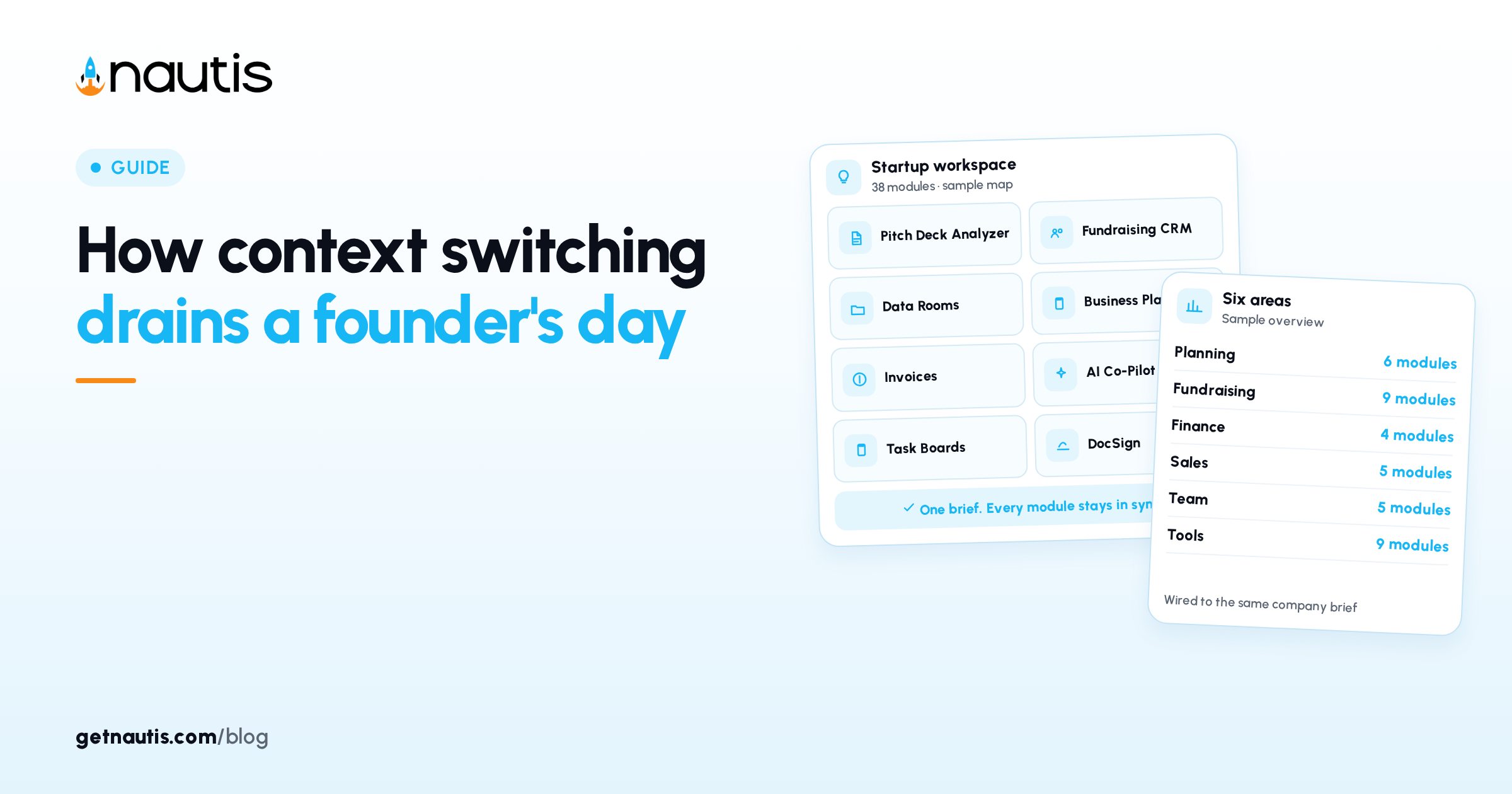
If your company runs work through Nautis, keep the active block inside that workspace instead of hopping across five SaaS tabs for the same job. Task boards can hold the making queue so you pick the next card without browsing five lists for priorities.
Phone face-down during making time is part of the workspace. A buzz is a remote switch with the same restart bill as a new tab.
When you must reference a second doc, paste the excerpt into the active note instead of leaving two full apps racing for attention. Tiny habit, fewer restarts.
Watch for fake single-tasking: one editor window with three unfinished drafts. Close the drafts you are not writing. Parallel drafts are parallel tasks.
Decide which interrupts may break making time
Some interrupts should win. Write the list so you do not invent exceptions under stress.
Allowed to break making time | Must wait for the next window |
|---|---|
Production down or security incident | Pure status questions |
Paying customer blocked on a bug you own | Vendor pitches and newsletters |
Cofounder decision that clears today's ship | "Quick thought" with no stake |
Family emergency | Optional intros |
Keep the list short enough to remember without a search. When you break your own rule, mark it on the switch log with a flag so patterns show up Friday.
Live meetings belong on the calendar with a purpose. If a meeting is only status, replace it with a written note and protect making time. Use Meetings and scheduling for holds that still earn a live slot.
Review the allow-list once a month. If "production down" never appears but "quick sync" always does, urgent has been redefined quietly. Fix the definition, not your willpower.
Recover after a noisy morning without rewriting the day
You will still have days with too many switches. Recover in twenty minutes, not with guilt.
Recovery steps:
- Write the three outcomes that still matter today.
- Cancel or shorten the lowest-value meeting.
- Pick one making block of at least forty-five minutes and defend it.
- Move leftover talking items to a single late window.
- Log two switches you will refuse tomorrow.
Do not try to catch up by juggling harder. That multiplies restart minutes. APA's page is blunt that multitasking "may seem efficient on the surface but may actually take more time in the end and involve more error," and Meyer's "as much as 40 percent" line is the headline figure on that same page (APA: Multitasking: Switching costs). As of November 2026 those statements remain there.
If the noisy morning was caused by a launch, accept a higher switch count for that day and restore grouping the next morning. Special weeks need an end date in writing or they become the new baseline.
Track recovery quality the same way you track switches: did the afternoon making block actually happen? A recovery plan that only rearranges guilt is not a plan.
A five-day trial you can run without new software
Day 1: log switches and sum restart minutes. Do not change behavior yet.
Day 2: install two talking windows and keep making time free of inbox.
Day 3: run one ninety-minute making block with one workspace and one draft.
Day 4: write your personal allow-list for breaks and stick it beside the monitor.
Day 5: compare restart minutes to Day 1 and keep only the rules that moved the number.
Optional stretch: move admin chores to a single afternoon slot and route receipts there. Founders often leak making time into expense tabs without noticing. If you already track spend in Expenses, open that module only inside an admin window.
If restart minutes barely moved, inspect the calendar first. Meetings that pretend to be short decisions are often talking in disguise. Relabel them or cut them before you buy another focus app.
When you compare weeks, prefer a rolling five-day average of restart minutes over a single quiet day. One calm Friday can hide a chaotic Tuesday. Keep a count of ships finished during making blocks beside that average so you do not celebrate a calm calendar that also shipped nothing.
If a cofounder wants instant answers during making time, offer a standing deciding window they can book instead of training both of you to live in chat. The switch log will show whether that bargain stuck.
The cost of context switching climbs when every ping counts as equal. Group the work, cap the loops, and let the log prove whether the week got quieter. The goal is not an empty inbox. The goal is fewer restarts on the work that ships.
Frequently asked questions
What is the cost of context switching for founders?
It is the restart time you pay each time you leave a task for chat, email, or another tool. Complex work usually costs more restart minutes than simple admin. A one-day log makes the bill visible.
What does APA say about switching costs?
APA's multitasking page says switch costs "may be relatively small, sometimes just a few tenths of a second per switch," and quotes Meyer that brief mental blocks "can cost as much as 40 percent of someone's productive time." Read the page for the full summary.
How do I measure context switching without fancy software?
Use a four-column log: time, task left, task started, restart minutes. Sum the restart column when you close the log. Tag rows that produced nothing so you can cut those first.
Should I group email and chat into the same window?
Yes for most early teams. Put both in talking windows with fixed start times. Keep making blocks free of inbox so shipping work is not rented by whoever messaged last.
Sources
- APA Multitasking: Switching costs. Checked on November 1, 2026.
- YC's essential startup advice. Checked on November 1, 2026.
- Nautis founders day-by-stage guide. Checked on November 1, 2026.
Baltej Singh is a serial entrepreneur, technology leader, and Founder & CEO of Nautis and DemoVexa, with over 16 years of experience building software products, SaaS platforms, and startups. Previously the Co-Founder & CTO of SanchiConnect, he has worked extensively in the DeepTech startup ecosystem, connecting with 200+ venture capital firms and supporting a network of 4,000+ startups. Passionate about AI, automation, and entrepreneurship, he focuses on building innovative products that solve real-world problems and help businesses grow.