How to run customer discovery interviews at a startup
 Baltej Singh8 min read
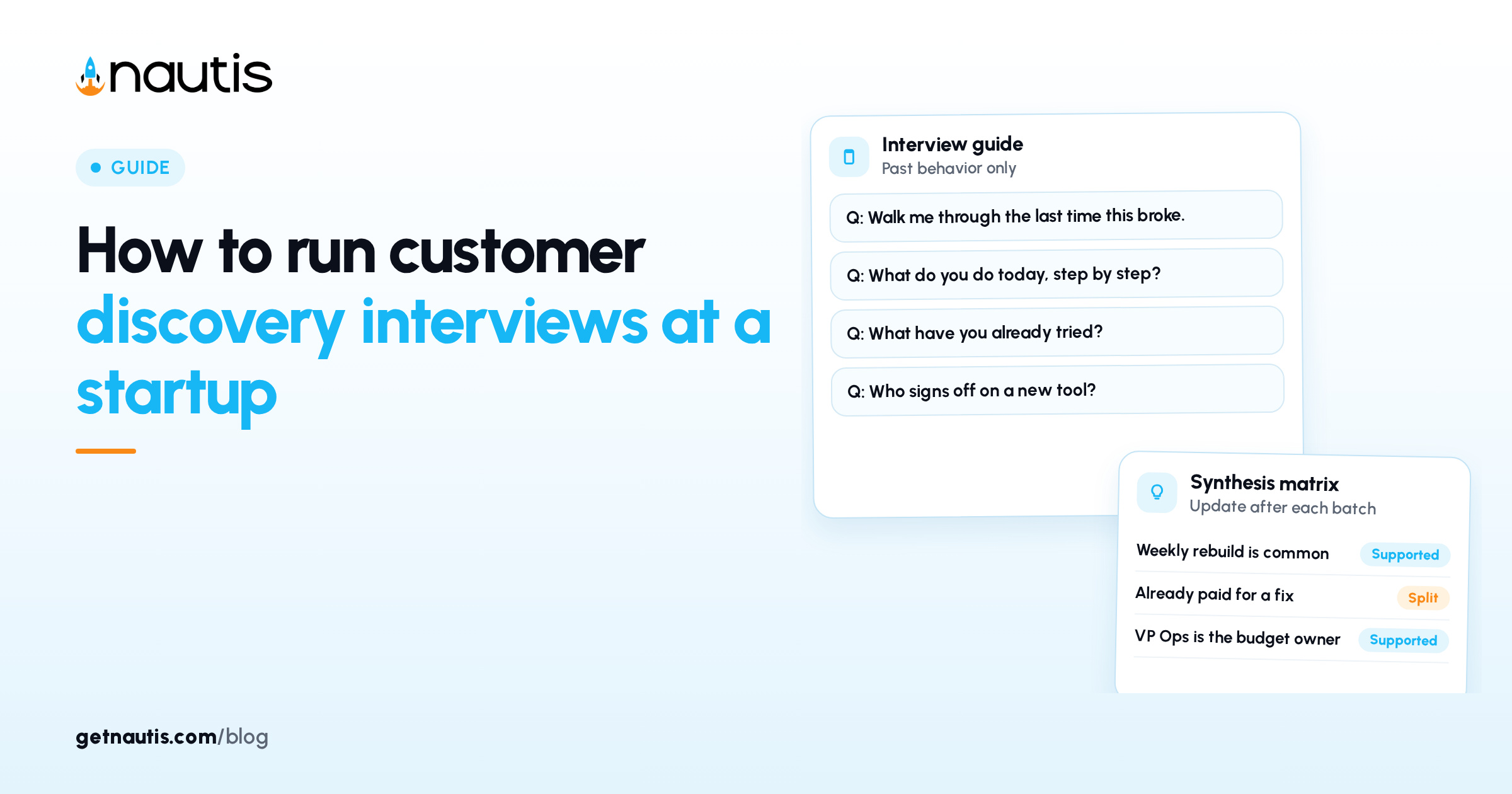
Customer discovery interviews are structured conversations that test whether a real segment feels a named problem badly enough to change how they work today. If you are searching for how to run customer discovery interviews, write one falsifiable learning goal, recruit people who recently hit that problem, ask about past behavior instead of your idea, then mark each hypothesis as supported, contradicted, or still unclear.
This guide is for early startup founders and product leads who need evidence before they build, price, or pitch. It follows the same customer discovery idea used in programs such as the U.S. National Science Foundation (NSF) Innovation Corps (I-Corps): talk to potential customers and other stakeholders to judge commercial fit, rather than starting with a product demo.
What customer discovery interviews are (and are not)
A customer discovery interview is a research call. The job is to learn how someone already handles a problem, what it costs them, and what they have already tried. It is not a sales demo, a user-test of your mockups, or a friendly chat that ends with “would you buy this?”
Format | Main question | When to use it |
|---|---|---|
Customer discovery interview | How do you handle this problem today? | Before you lock scope or positioning |
Will early users complete a real workflow? | After you have something they can try | |
Feature request review | Which asks map to a shared job? | When paying users send product ideas |
Sales call | Should this buyer start a deal? | When the offer and price are ready |
Keep discovery separate from selling. The moment you pitch, people start reacting to your story instead of describing their own. Save demos for a later step, after the notes show a clear pattern.
Write one falsifiable learning goal before you book anyone
Do not open the calendar until you can finish one sentence: “I want to learn whether [segment] currently struggles with [problem], and how they handle it today.” That sentence is your learning goal. Under it, list the assumptions that would kill the idea if they were wrong.
Assumption (example) | What would support it | What would contradict it |
|---|---|---|
Operations managers at 20 to 100 person B2B firms rebuild the same weekly report by hand | Interviewees describe a recent Friday rebuild with tools and hours | Interviewees say a report already runs without manual work |
The rebuild costs more than one focused hour each week | They name a weekly time cost or a missed decision | They call it a rare annoyance |
Someone on the team already tried a tool or hire | They name a past purchase, spreadsheet, or contractor | They have never searched for a fix |
Label every row as an example until it matches your product. One segment per study. If you want to learn about two segments, run two separate interview sets with two learning goals. Mixing them in one notebook makes false patterns look real.
How do you recruit people who fit the segment?
Recruit people who recently felt the problem, not friends who will be polite. A short screener on the booking form filters out the wrong calls before they land on your calendar.
Screener question | Keep if… | Pass if… |
|---|---|---|
When was the last time you [trigger event]? | Inside your relevance window (for example, the last 90 days) | “Years ago” or “never” |
What did you use to handle it? | They name a tool, person, spreadsheet, or process | “Nothing” with no workaround |
What is your role when that work happens? | Matches the buyer, user, or influencer you named | Unrelated role with no contact to the work |
Two or three closed questions are enough. Ask them on the form, not as the first five minutes of the call. For outreach, explain that you are researching how teams handle a specific workflow, offer a clear length (for example, 25 minutes), and say you are not selling on the call.
Create a bookable event type in Meetings so people can pick a slot without email ping-pong. Save each person in Contacts with a tag such as “discovery-nov” so you can find the cohort later. If a transcription tool is connected to Meetings, you can copy the summary into Notes after the call; still ask for recording consent first, and follow the consent rules that apply where you and the interviewee are located.
The interview guide: questions that pull past behavior
Write eight to ten open questions that force a specific memory. Past behavior beats hypotheticals. Avoid “Would you use…?” and “What would the perfect product do?”
Stage | Ask | Listen for |
|---|---|---|
Open | Walk me through the last time [problem] showed up. What were you doing right before? | Trigger, timing, who was in the room |
Cost | What did that cost you in time, money, or work you delayed? | Units they already track |
Workaround | What do you do today, step by step? | Tools, people, meetings, scripts |
Alternatives | What have you already tried, including spreadsheets, hires, or vendors? | Switching history and why it failed |
Priority | On a scale from mild annoyance to “I would drop other work to fix this,” where does it sit, and when did it last hit the top end? | Urgency that matches real action |
Buying path | If you brought in a new tool for this tomorrow, who would need to sign off? | Budget owner and process |
Close | What should I have asked that I did not? Who else deals with this? | Blind spots and warm intros |
Treat the table as a backbone, not a script. Follow the thread when someone names a cost or a failed tool. Keep a short backup list of probes: “What happened next?”, “How do you know?”, “Who else felt that?”
Pilot the guide once with a colleague or a friendly operator. Pilots usually catch a biased question or a phrase that only makes sense inside your company.
How to run customer discovery interviews without pitching
Open in two minutes. Say you are there to learn how they handle [problem] today, that there are no right answers, and that specifics help more than compliments. Confirm the time box and whether you may take notes or record.
Then stay in their world:
- Ask for the last time the problem happened, and stay on that story until you have trigger, workaround, and cost.
- Use silence. After they finish a sentence, wait a few seconds before you speak.
- Capture exact phrases in your notes, not your interpretation. “She spends Friday rebuilding three exports” is evidence. “She is frustrated by reporting” is not.
- Do not explain your product until the research questions are done. If they ask what you are building, give one plain sentence and return to their workflow.
- Close with thanks, ask who else you should talk to, and send a short thank-you the same day.
Store the write-up in Notes while the call is fresh: title, segment, date, learning goal, quotes, and a one-line verdict on each assumption. Pin the note or put it in a “Customer discovery” folder so the next interviewer can find the pattern without hunting chat history.
How do you turn notes into a decision?
Interviews only help if you synthesize. After every few calls in the same segment, fill a matrix before you book more of the same people.
Hypothesis | Supported by (quotes or facts) | Contradicted by | Status | Next action |
|---|---|---|---|---|
Weekly manual rebuild is common in segment | Three ops managers described a Friday ritual | One team had an automated export | Unclear, lean supported | Interview two more non-customers in the same role |
Teams already paid for a partial fix | Two named a BI add-on they abandoned | Two never searched | Split | Separate “tried tools” vs “never searched” in notes |
Budget owner is the VP Ops | Four said VP Ops signs software under a set threshold (example threshold: confirm in each call) | One needed finance plus security review | Supported for mid-market | Capture security review as a later sales risk |
NSF I-Corps national teams are expected to complete at least 100 interviews during their seven-week program because volume exposes weak assumptions. An early startup outside that program still needs enough calls that new interviews start repeating the same themes before you treat a pattern as real. When themes stabilize, decide in writing: keep the segment, change the problem statement, or stop.
Move follow-ups onto a Task Board: “Rewrite learning goal,” “Book two more finance buyers,” “Draft PRD from supported jobs.” If discovery points at a build, fold the evidence into a product requirements document and keep feature requests in a separate queue so research and backlog do not blur.
Keep discovery running without a research team
A repeatable loop beats a one-off sprint:
- One learning goal and assumption table per study
- One screener and booking link per segment
- One note template every interviewer uses
- A weekly 30-minute synthesis meeting that updates the matrix and the next recruiting list
Nautis can hold the operating pieces in one workspace: Contacts for the people you spoke with, Meetings for the booking link and calendar holds, Notes for transcripts and synthesis, and Task Boards for the actions that come out of each review. The Chief of Staff can surface blockers from those tools in the daily Briefing when they are connected in your workspace. None of that replaces the hard part: asking about their last bad week, and listening until the pattern is boring.
When discovery shows a problem worth solving, your next documents get easier because they inherit real quotes, costs, and owners instead of guesses.
Frequently asked questions
How many customer discovery interviews should a startup run?
NSF I-Corps national teams are expected to complete at least 100 interviews in seven weeks. Outside that program, keep interviewing one segment until new calls repeat the same themes, then decide in writing whether to keep, change, or stop.
What is the difference between a customer discovery interview and a sales call?
A discovery interview learns how someone handles a problem today. A sales call checks whether a ready offer fits a buyer. Mixing them biases the answers, so finish research before you demo.
Should I show my product in a customer discovery interview?
No. Ask about their last real incident, workaround, and cost first. If they ask what you are building, give one plain sentence and return to their workflow.
How do I take notes during customer discovery interviews?
Capture exact quotes, the trigger, the workaround, and any cost they named. Write the synthesis the same day in a shared note so patterns are visible to the next interviewer.
Sources
- NSF I-Corps National Teams applicants. Checked on November 20, 2026.
- NSF I-Corps information for accepted national teams. Checked on November 20, 2026.
- Steve Blank, Customer Development. Checked on November 20, 2026.
- Nautis Help Center, Meetings. Checked on November 20, 2026.
- Nautis Help Center, Notes. Checked on November 20, 2026.
Baltej Singh is a serial entrepreneur, technology leader, and Founder & CEO of Nautis and DemoVexa, with over 16 years of experience building software products, SaaS platforms, and startups. Previously the Co-Founder & CTO of SanchiConnect, he has worked extensively in the DeepTech startup ecosystem, connecting with 200+ venture capital firms and supporting a network of 4,000+ startups. Passionate about AI, automation, and entrepreneurship, he focuses on building innovative products that solve real-world problems and help businesses grow.