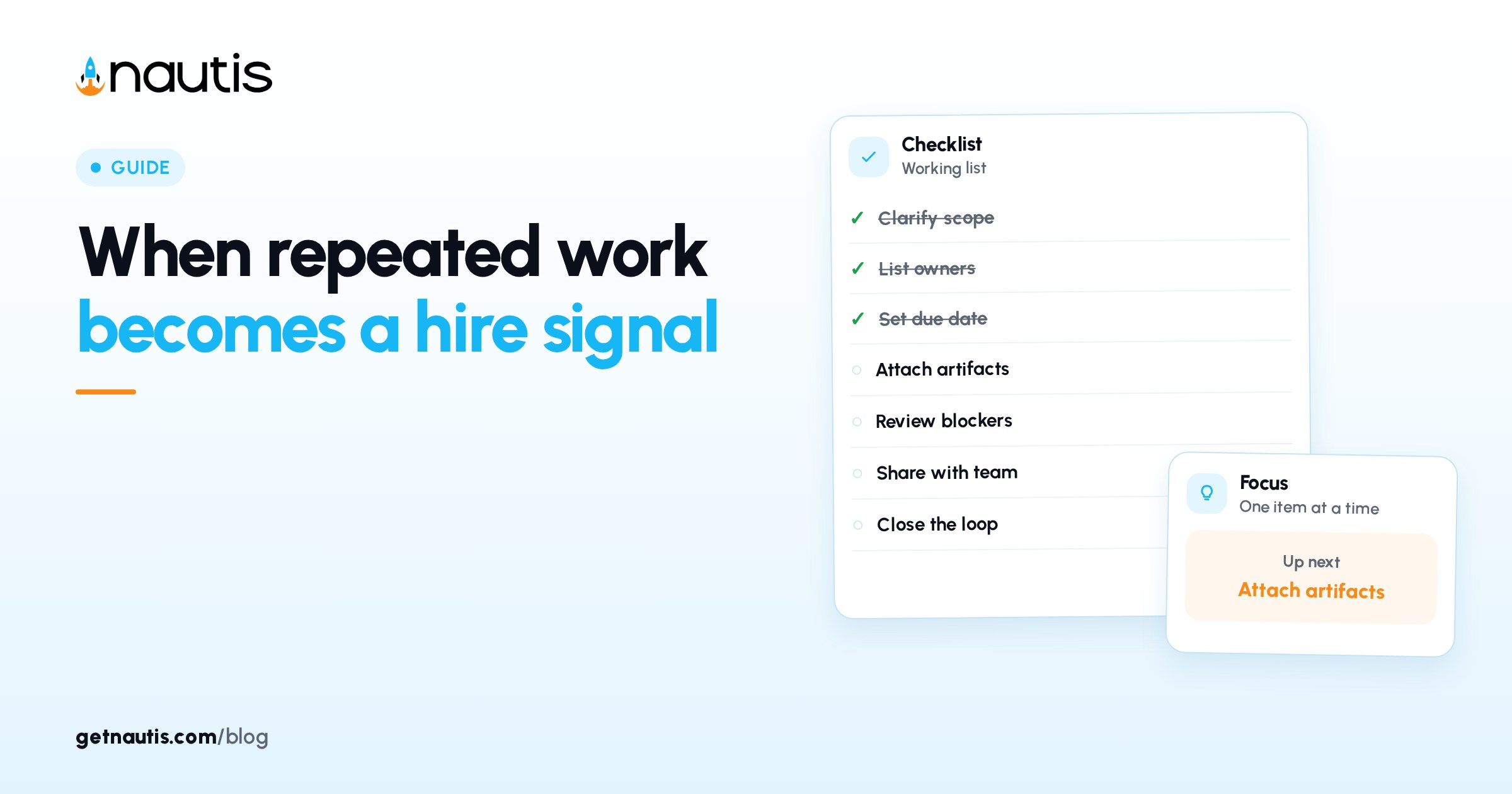
When repeated work becomes a hire signal
 Baltej Singh9 min read
Founders often feel buried before they can explain why. The missing artifact is not another productivity app. It is a clear rule for when repeated work becomes a hire signal: how often the work recurs, what it costs in senior attention, and whether a short handoff brief would let someone else own it.
This guide is a staffing checklist. It starts from calendar evidence, not from a documentation program. The question is whether repetition has crossed into "this should be a role," and what evidence you need before you open Jobs & Recruitment.
When repeated work becomes a hire signal
Use four tests. Treat the thresholds as example numbers for illustration only, not universal law. Adjust them to your burn and stage.
Signal | Example threshold (illustration only) | What to write down |
|---|---|---|
Frequency | Same task ≥2 times per week for 4 weeks | Task name, last four dates, minutes each time |
Senior time | Founder or lead spends ≥5 hours/week on it | Who else could do 80% with a page and access |
Handoff risk | Work stops when one person is sick or traveling | Single point of failure: yes/no |
Quality drift | Two recent mistakes from "keeping it in my head" | Mistake, cost, whether a checklist would have caught it |
If three of four signals light up, you likely have a hire signal or a contractor signal.
Convert senior hours into rough cash so the signal competes with other spend. Example for illustration only: five founder hours weekly at a blended opportunity cost you treat as $150/hour is about $3,000/month of attention. A contractor at $2,000/month who removes four of those hours can be rational even before a full-time seat. Write your own rates; the arithmetic is the point.
Also separate customer-facing loops from internal admin loops when you brief a future hire. Mixing both into one scorecard often produces someone stretched across empathy work and spreadsheet work with no clear win condition. If only frequency lights up but senior time is low, automate or template first. If senior time is high but frequency is low, keep it founder-owned for now.
YC's essential advice keeps early teams focused on real work and evidence over ceremony (Y Combinator Library, checked 1 Nov 2026). A hire signal should be boring enough to put in a note: dates, hours, failures, not a vibe.
Count the work before you name the role
Open a single running log for two weeks. In Notes, create one log titled with the task, not the person. After each occurrence, add: date, minutes, trigger, output, and whether a non-founder could have finished it with written steps.
Example for illustration only: "Customer refund exceptions" appears nine times in fourteen days, 25-40 minutes each, always after a support email, always needs Stripe access plus a policy call. That log is stronger than "refunds are eating my week."
Do not start with a job title. Titles invent scope. Logs reveal scope. Many "ops hire" feelings are actually three unrelated loops: refunds, invoice fixes, and calendar triage. Split the log by loop before you write a scorecard.
If the loop is mostly waiting on other people, hiring will not fix it. Fix the queue or the SLA first. A new person stuck in the same waiting pattern burns cash without removing the founder bottleneck.
Be honest about "urgent" interruptions that are actually the same loop wearing different subject lines. If five Slack pings a day all resolve with the same three clicks and the same policy sentence, they belong in the frequency count as one recurring task type, not as five unique fires. Collapsing them in the log is how the hire signal becomes visible.
Also log the recovery cost after travel. When a founder returns from three days offline and spends half a day catching up on the same loop, that catch-up time counts toward senior hours. Hidden backlog work is still repeated work.
Decide: documented handoff, contractor, or full-time seat
Not every hire signal needs a full-time employee. Use a simple fork:
- Documented handoff if a capable teammate already exists and the work is rules-based. Write five to nine steps, name an owner, and watch them run it twice while you stay available for exceptions.
- Contractor if the work is bursty, specialized, or not yet weekly. Buy a defined outcome for a defined window.
- Full-time seat if the loop is weekly, growing, and tied to a durable function (support, finance ops, recruiting coordination).
Record the fork decision in the same Notes log with a date. Revisit in thirty days. Example illustration only: if after a handoff the founder still spends three hours a week on exceptions, the brief is incomplete or the volume justifies a seat.
Keep Employee Management records accurate when someone does take ownership (Employee Management). Role clarity on paper beats a Slack nickname that "kind of owns refunds."
Make the handoff brief a staffing artifact
When you choose a documented handoff or you prepare a hire, the written steps belong in the staffing packet. They prove the seat is real. Include purpose, what starts the work, the sequence a new person follows, systems and permissions, definition of done, who to escalate to, and a review date.
Keep the brief beside the live work. Link the brief from the Task Boards card or recurring task for that loop so nobody has to hunt a drive folder mid-task.
Do not collect unfinished drafts. The hire-signal question is whether this loop deserves a human with clear volume and access - not whether you can fill a binder.
Open the role only with a scorecard from the log
If the fork says full-time, translate the log into a scorecard before you post:
- Outcomes for the first 30/60/90 days taken from real volume in the log
- Tools and permissions the person must use in week one
- Decisions they may make alone versus escalate
- Neighbor roles who will feel the handoff
Publish the role through Jobs & Recruitment only after that scorecard exists. A vague "ops generalist" post is usually a pile of unlogged loops wearing a single title.
During interviews, ask candidates to narrate how they would run your actual brief on day five, not how they "build process" in the abstract. Strong answers edit your steps; weak answers add frameworks without touching your triggers.
Candidates sometimes optimize for narrative. Anchor the conversation in last month's log: how many times the loop ran, how long it took, which tools it touched. Ask them what they would measure in week two to prove the founder hours are falling. Answers that stay in slogans usually fail the same way vague scorecards fail.
Scorecards fail when they list soft traits ("scrappy," "owner mentality") without tying them to the logged loop. Prefer lines like "process 20 refund exceptions per week within policy" over "handle ops chaos." Candidates can self-select when the volume is real. You also get a cleaner thirty-day review: either the volume moved off the founder calendar or it did not.
If two loops each warrant half a seat, resist gluing them into one confused role unless the skills overlap. A bookkeeping-heavy loop and a customer-empathy loop often need different people. Two narrower scorecards beat one overloaded generalist post that nobody can succeed at.
Review the signal monthly so hires stay intentional
Put a thirty-minute monthly review on the calendar. For each loop on the watch list, update frequency, senior hours, handoff risk, and quality drift. Retire loops that quieted down. Promote loops that crossed thresholds.
Tie the review to how you already plan the week: protect deep work by removing recurring drains that now have owners. If every month adds a seat without retiring a founder loop, you are staffing around avoidance rather than deliberate ownership.
Example illustration only: a team that hires support while the founder still triages every refund exception has not converted the signal into a handoff. Fix the brief and permissions before the next req.
Watch the first two weeks after a handoff the way you watch a metric. If the founder calendar still shows the old loop blocks, the signal did not convert. Either permissions failed, the brief missed an exception path, or volume exceeds what a side duty can absorb. Those are different fixes. Only the third one is a new seat.
For full-time seats, schedule a thirty-day readout that compares founder hours on that loop before and after start date. Example illustration only: hours drop from six weekly to one weekly of escalations. If hours do not drop, you hired a parallel worker while keeping the old bottleneck. reassign ownership explicitly in Employee Management and in the tools themselves.
During the monthly review, kill vanity loops. If a task fell below your frequency bar for two months, remove it from the watch list and archive the brief. A long list of quiet tasks recreates the wiki problem under a new name. The hire-signal system only works when the list stays short and current.
FAQ
When does repeated work become a hire signal?
When frequency, senior time, handoff risk, and quality drift show the loop is durable and costly. Example illustration only: twice weekly for a month, five or more founder hours weekly, and failure when one person is away.
Should I write a handoff brief before hiring?
Yes, at least a thin handoff brief. It clarifies the seat, trains the first owner, and shows whether a teammate or contractor can absorb the loop without a full-time hire.
What if the work is repeated but strategic?
Keep strategic judgment with a founder or lead. Hire or delegate the prep and follow-through around that judgment. The log should separate thinking time from mechanical steps.
Where do I track roles and applicants in Nautis?
Use Employee Management for people and roles you already have, and Jobs & Recruitment when you are ready to post and manage applicants for a scorecard-backed seat.
Frequently asked questions
When does repeated work become a hire signal?
When frequency, senior time, handoff risk, and quality drift show the loop is durable and costly. Write the evidence down before you open a role.
Should I write a handoff brief before hiring?
Yes. A thin brief clarifies the seat and shows whether a teammate or contractor can absorb the loop without a full-time hire.
What if the work is repeated but strategic?
Keep strategic judgment with a founder or lead. Hire or delegate the prep and follow-through around that judgment.
Where do I track roles and applicants in Nautis?
Use Employee Management for people you already have, and Jobs & Recruitment when you post and manage applicants for a scorecard-backed seat.
Sources
- Y Combinator Library, Essential startup advice. Checked on November 1, 2026.
- Nautis Docs, Jobs & Recruitment. Checked on November 1, 2026.
Baltej Singh is a serial entrepreneur, technology leader, and Founder & CEO of Nautis and DemoVexa, with over 16 years of experience building software products, SaaS platforms, and startups. Previously the Co-Founder & CTO of SanchiConnect, he has worked extensively in the DeepTech startup ecosystem, connecting with 200+ venture capital firms and supporting a network of 4,000+ startups. Passionate about AI, automation, and entrepreneurship, he focuses on building innovative products that solve real-world problems and help businesses grow.